


Summary
Here's a revised version with more varied rhythm and a natural voice:
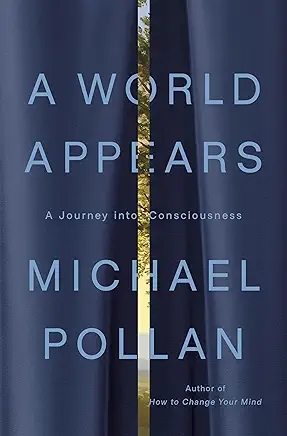
In "A World Appears: A Journey into Consciousness," Michael Pollan takes on one of humanity's most enduring puzzles: what is consciousness, and how does our inner life—that constant stream of sensations, memories, emotions, and self-awareness—actually arise? Published in 2026 as a follow-up to his groundbreaking "How to Change Your Mind," the book delivers precisely the kind of boundary-crossing inquiry that IMHU advocates for. Pollan refuses to confine himself to Western neuroscience alone, recognizing that no single paradigm holds a monopoly on understanding something as vast and mysterious as consciousness itself.
What makes this exploration compelling is its refusal to choose between rigor and wonder. Pollan spends time with researchers studying the possibility of consciousness in plants, with scientists attempting to kindle genuine feeling in artificial intelligence, with philosophers puzzling over the "hard problem" of subjective experience. But he also sits with Buddhist monks, learns from indigenous wisdom keepers, and consults novelists who've spent lifetimes mapping the terrain of human awareness through story. His journey unfolds over six years, carrying him from gleaming brain labs in Seattle to a secluded cave in New Mexico, where he arrives at a provocative conclusion: maybe practicing consciousness—learning to inhabit it more fully—matters more than dissecting it.
For anyone navigating spiritual awakening or non-ordinary states, Pollan's work offers crucial validation. He treats these experiences not as aberrations requiring pharmaceutical correction, but as potentially transformative encounters with consciousness at its most expansive. His integrative approach mirrors what IMHU has long understood: human flourishing demands that we honor the whole person—mind and body, yes, but also relationships, spirit, and our fundamental need for meaning beyond ourselves. This book belongs on the shelf of anyone serious about consciousness as both subject of study and path of practice.
The Limits of Materialist Science
Pollan challenges the early assumption of consciousness researchers that the brain alone generates subjective experience, exploring how the materialist scientific approach may lack the proper tools to understand first-person consciousness (Michael Pollan, Amazon). The book traces how neuroscience initially set out in the 1990s with confidence that consciousness could be explained purely through brain mechanics, but that effort is faltering, opening space for more radical theories like panpsychism (Amazon). This argument resonates with IMHU's recognition that Western biomedical models don't hold a monopoly on understanding human experience. Just as Pollan finds that objective science struggles to capture subjective reality, IMHU understands that clinical frameworks alone cannot encompass the depth of spiritual experience or the transformative potential of non-ordinary states. They must be considered in tandem with a biomedical perspective of well-being.
Consciousness Beyond the Human
The book explores consciousness in unexpected places—from plants that may experience something like feeling, to AI systems being engineered for sentience (Amazon.) Pollan notes that psychedelic experience seems to expand people's willingness to recognize consciousness in nonhuman beings, potentially even at the level of viruses (PenguinRandomhouse.com.) This investigation pushes against anthropocentric assumptions about who or what deserves moral consideration and suggests that consciousness may be more fundamental to nature than we've imagined. The exploration mirrors indigenous and Eastern perspectives that have long recognized intelligence and spirit distributed throughout the natural world—perspectives IMHU values for their contributions to holistic understanding.
Practice Over Explanation
Perhaps the book's most provocative conclusion is that explaining consciousness may be less urgent than learning to practice it in our everyday lives (Barnes & Noble.) After journeying from brain laboratories to encounters with Buddhist monks and philosophers, Pollan's story ends in a cave in New Mexico where he discovers the importance of cultivating consciousness rather than merely analyzing it (Barnes & Noble.) This shift from theoretical understanding to embodied practice aligns perfectly with IMHU's emphasis on spiritual practice as essential to human flourishing. It's not enough to conceptualize well-being—we must actively engage in practices that deepen our awareness and connection to something transcendent.
Multiple Ways of Knowing
Throughout the book, Pollan deliberately brings together scientific, philosophical, literary, spiritual, and psychedelic perspectives, treating each as legitimate sources of insight about consciousness (Michael Pollan, PenguinRandomhouse.com.) He spends time with neuroscientists and Buddhist monks, philosophers and novelists, recognizing that contemplative practitioners may have as much or more to teach us about consciousness than laboratory researchers (Amazon.) This pluralistic approach embodies IMHU's core conviction that genuine understanding requires integrating wisdom across cultural paradigms rather than privileging any single framework.