


Summary
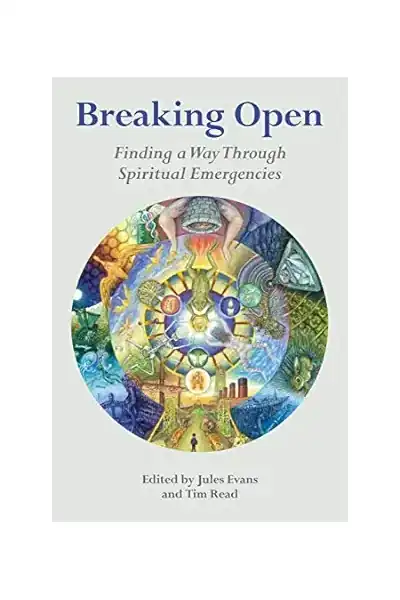
In "Breaking Open," Jules Evans and Tim Read assemble what amounts to a field guide for one of the most neglected and misunderstood phenomena in mental health: the spiritual emergency. Evans, a philosopher and journalist who has written extensively about the intersection of philosophy, psychology, and spiritual experience, and Read, a psychiatrist with decades of experience working at the boundaries of conventional and transpersonal care, bring together first-person accounts, clinical perspectives, theoretical frameworks, and practical guidance into a resource that fills a glaring gap in both the psychiatric and spiritual literature. The book takes its title seriously—these experiences break people open, sometimes catastrophically, and finding a way through requires knowledge, support, and frameworks that our current systems largely fail to provide.
What makes "Breaking Open" particularly valuable for IMHU's community is its unflinching honesty about both sides of the spiritual emergency equation. The editors don't romanticize these experiences or minimize their danger. People in spiritual emergency can lose their jobs, their relationships, their sense of identity, and their grip on consensual reality. Some end up in psychiatric wards where their experiences are treated as symptoms of psychosis and suppressed with medication. Others find their way to spiritual communities that encourage them to "go deeper" when what they actually need is grounding and stabilization. The book navigates between these extremes, insisting that spiritual emergencies are real, potentially transformative, genuinely dangerous, and desperately in need of responses that neither pathologize them nor romanticize them. This is the territory IMHU was created to address, and this book provides one of the most practical and balanced guides to navigating it.
First-Person Voices from the Crisis
The book's greatest strength may be the quality and diversity of its first-person accounts. People who have been through spiritual emergencies describe their experiences in their own words, and the range is remarkable: kundalini awakenings that produced overwhelming physical energy and altered perception; psychotic-like episodes triggered by meditation retreats; spontaneous mystical experiences that erupted without warning and left the person unable to function; near-death experiences that permanently altered the person's relationship with reality; psychedelic experiences that catalyzed prolonged periods of perceptual and psychological upheaval. Each account is unique in its details, yet patterns emerge: the sudden dissolution of ordinary identity, the flooding of consciousness with material that feels more real than everyday reality, the terror of not knowing what is happening, the desperate search for someone who can help.
These accounts serve a crucial function. For people currently in or recovering from spiritual emergency, they provide the recognition that someone else has been through something similar and survived. This alone can be profoundly therapeutic in a culture that offers no public narrative for these experiences beyond "you're having a psychotic break." For clinicians, the accounts provide phenomenological data that no clinical description can match—the lived texture of what these experiences actually feel like from the inside. And for researchers and theorists, they provide the raw material from which better frameworks and interventions can be developed. Evans and Read let the voices speak without imposing premature interpretation, trusting that the experiences themselves will demonstrate both their reality and their complexity more convincingly than any theoretical argument could.
The Framework Problem
Evans and Read address directly what they see as the central problem for people experiencing spiritual emergencies: the absence of adequate frameworks for understanding what is happening to them. In mainstream psychiatry, these experiences are typically categorized as psychotic episodes, manic episodes, or dissociative disorders—diagnostic categories that capture certain features of the presentation while missing others entirely. In many spiritual traditions, they might be interpreted as kundalini awakening, shamanic initiation, dark night of the soul, or spiritual breakthrough—frameworks that validate the spiritual dimension of the experience but may underestimate its psychological dangers and the need for practical support.
The book argues that neither framework alone is adequate. The psychiatric framework correctly identifies the risk of these experiences and provides interventions for acute crisis, but it typically fails to recognize the potentially transformative nature of what's occurring and may suppress the process prematurely through heavy medication. The spiritual framework correctly identifies the transformative potential and provides meaning-making resources, but it may fail to recognize when someone needs medical intervention, practical grounding, or protection from real harm. What's needed—and what the book works toward—is an integrative framework that can hold both dimensions simultaneously: honoring the spiritual significance of the experience while providing the clinical competence to keep the person safe. This is precisely the kind of framework IMHU is working to develop and disseminate, and "Breaking Open" contributes essential building blocks.
What Helps and What Harms
Among the book's most practically valuable sections are those addressing what actually helps and what actually harms during a spiritual emergency. The contributors identify several factors that tend to support positive outcomes: having at least one person in the experiencer's life who can accept what's happening without panic or pathologizing; access to a framework that provides meaning for the experience without encouraging further destabilization; basic physical grounding through sleep, nutrition, nature contact, and gentle physical activity; reduction of stimulation and information overload; and time—the recognition that these experiences often need to unfold at their own pace and can't be resolved by force of will or clinical intervention alone.
Equally important is the identification of what tends to cause harm. Forced hospitalization and heavy sedation can truncate a potentially transformative process, leaving the person with unprocessed material that may resurface later in more problematic forms. Being told that one's experience is "just" a chemical imbalance or psychotic episode invalidates what may be the most significant event of the person's life. Being encouraged by spiritual teachers or communities to "surrender to the process" without adequate grounding and support can allow a manageable crisis to escalate into a genuinely dangerous one. And the absence of any form of support—facing the experience entirely alone, with no framework and no one to turn to—is perhaps the most harmful condition of all, transforming what might have been a difficult but integrable experience into an isolated, terrifying, and potentially permanently destabilizing one.
The Role of Community and Peer Support
Evans and Read emphasize that one of the most critical and most neglected resources for people in spiritual emergency is community—specifically, the company of others who have been through similar experiences and emerged with their lives intact. The isolation that typically accompanies spiritual emergency is itself a major source of harm. In a culture that has no public framework for these experiences, people in crisis often feel completely alone, convinced that what's happening to them has never happened to anyone else, terrified that disclosing their experience will result in being labeled crazy and losing everything they've built.
The book documents the growing network of peer support initiatives, spiritual emergency helplines, and community organizations that have emerged to address this need—often created by people who went through their own spiritual emergencies and discovered that the existing systems had nothing to offer them. These initiatives share common features: they're staffed by people with lived experience, they offer non-pathologizing listening and validation, they provide practical information about what's happening and what helps, and they connect people with clinicians and resources that understand the spiritual dimensions of their experience. For IMHU, this emphasis on peer support and community networks aligns with the organization's understanding that transforming how spiritual emergencies are handled requires not just better clinical frameworks but entirely new support structures that exist outside—and sometimes in creative tension with—the conventional mental health system.
Building Better Responses
The book's final sections look forward, sketching what a more adequate societal response to spiritual emergency might look like. Evans and Read envision a world in which psychiatric training includes education about spiritual experiences and their distinction from psychopathology. In which crisis services include options beyond medication and hospitalization—safe spaces, trained companions, and graduated levels of support that match the intensity of the person's experience. In which spiritual communities develop better capacity to recognize when their members need clinical help and to facilitate that transition without stigma. In which research funding is directed toward understanding the mechanisms, risk factors, and optimal interventions for spiritual emergency with the same rigor applied to any other clinical condition.
These aren't utopian fantasies. Some of them are already being implemented in scattered locations around the world, and the book documents several promising models. But the gap between what exists and what's needed remains enormous. Most psychiatrists still receive no training in distinguishing spiritual experience from psychopathology. Most crisis services still default to medication and containment. Most spiritual communities still lack the clinical knowledge to recognize when their members are in genuine danger. And most people who experience spiritual emergencies still face a choice between a psychiatric system that will pathologize them and a spiritual system that may endanger them—with very little in between. "Breaking Open" is ultimately a call to build that in-between space: a place where the spiritual significance of these experiences is honored while the clinical competence to manage their risks is also present. That space is what IMHU exists to create, and this book provides both the blueprint and the urgency for creating it.