


Summary
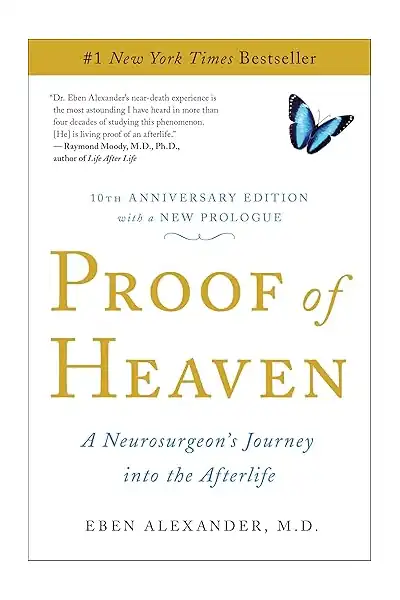
In "Proof of Heaven," Eben Alexander—a Harvard-trained neurosurgeon who spent decades operating on brains and dismissing consciousness as nothing more than their output—describes the near-death experience that demolished his materialist worldview. In 2008, Alexander contracted a rare form of bacterial meningitis that shut down his neocortex—the part of the brain that neuroscience considers essential for conscious experience—for seven days. According to everything he had been taught and had taught others, he should have experienced nothing during this period. Instead, he experienced what he describes as the most vivid, coherent, and real experience of his life: a journey through realms of extraordinary beauty, guided by a luminous being, with direct apprehension of a divine reality characterized by unconditional love and interconnection.
The book became a massive bestseller and ignited fierce debate in both scientific and spiritual communities. Skeptics challenged Alexander's claims about the extent of his cortical shutdown and proposed conventional neurological explanations for his experience. Supporters pointed to the unusual circumstances of his case—particularly the documented severity of his brain infection and the depth of his coma—as making standard explanations like REM intrusion, oxygen deprivation effects, or partial brain function less plausible than in typical NDE cases. For IMHU's community, the book's significance lies less in settling the debate about what happened to Alexander's consciousness during his coma and more in what his story reveals about the relationship between scientific authority, personal experience, and the willingness to revise one's worldview when the evidence demands it.
A Materialist's Conversion
What gives Alexander's account its particular force is his starting point. He wasn't a spiritual seeker who interpreted an ambiguous experience through a pre-existing mystical framework. He was a committed materialist who had spent his career inside one of the world's most prestigious neuroscience establishments, operating on brains and assuming—as his training taught him—that consciousness was entirely produced by neural activity. When colleagues or patients raised questions about near-death experiences or the possibility of consciousness beyond the brain, he dismissed them with the confident certainty of someone who knew how brains worked. He was, by his own admission, exactly the kind of person who would never have taken an NDE report seriously.
This is precisely why his experience was so destabilizing for him and so provocative for the broader culture. Alexander couldn't dismiss what happened to him using the explanations he had routinely offered to others. He knew the neuroscience too well. He knew what a brain in his condition should and shouldn't have been capable of generating, and the richness, coherence, and hyper-real quality of his experience didn't match any known mechanism for residual brain function during coma. His conversion from confident materialist to reluctant mystic followed a pattern that's remarkably common among people who have profound NDEs: the experience was so far beyond what their previous worldview could accommodate that it forced a fundamental revision of their understanding of reality—not as a choice but as a necessity imposed by the sheer weight of what they'd experienced.
The Experience Itself
Alexander describes his NDE as progressing through several distinct phases. Initially, he found himself in a dark, murky environment—a realm he calls the "Realm of the Earthworm's-Eye View"—characterized by primordial sounds and an absence of visual clarity. He then transitioned into an extraordinarily vivid landscape of immense beauty: lush meadows, crystalline pools, beings of light, and a profound sense of being loved unconditionally. A luminous feminine presence accompanied him, communicating not through words but through a direct transfer of understanding. He then moved into what he calls "the Core"—a vast, infinite darkness that was simultaneously the source of all light and all love, a presence he identifies as God or the divine ground of being.
The phenomenological details of Alexander's experience align closely with the features identified by NDE researchers over decades: the progression through distinct realms, the encounter with beings of light, the experience of unconditional love, the direct noetic apprehension of truths beyond verbal expression, and the profound reluctance to return to ordinary embodied consciousness. What distinguishes his account is the neurological context: the severe and well-documented impairment of the brain structures that materialist neuroscience considers necessary for generating these kinds of experiences. If his neocortex was truly as compromised as his medical records indicate, then the experience either occurred through unknown neural mechanisms, or it occurred through some process that doesn't require an intact neocortex—a possibility that would fundamentally challenge the materialist model of consciousness.
The Scientific Controversy
Alexander's claims have been challenged by scientists who argue that the severity of his brain shutdown may have been overstated, that some cortical function may have persisted, or that the experience may have been generated during the transition into or out of coma rather than during the deepest period of cortical suppression. These are legitimate scientific questions that deserve serious engagement, and the debate they've generated has been valuable for focusing attention on the empirical specifics of NDE cases rather than treating them as uniformly explicable or uniformly miraculous.
Alexander has responded to these criticisms in detail, pointing to his medical records, the documented extent of his meningitis, and the opinion of his treating physicians that his neocortex was severely compromised throughout his coma. The debate remains unresolved, and it may be unresolvable with current methods—we simply don't have the tools to determine with certainty what a brain is and isn't doing during a deep coma. What's notable, however, is the quality of the resistance his claims have provoked. Many of the most vehement critics have dismissed his experience without engaging with its specific details, falling back on the general argument that consciousness can't exist without a functioning brain because materialism says it can't. This circular reasoning—rejecting evidence because it contradicts a conclusion that the evidence is supposed to inform—is exactly the kind of dogmatic thinking that Sheldrake, Mack, and others in IMHU's library have identified as the primary obstacle to genuine scientific progress on questions of consciousness.
Messages from the Other Side
The content of what Alexander reports learning during his NDE—the "messages" he received—echoes with remarkable consistency the insights reported by NDEers across cultures and across decades of research. The fundamental message, as Alexander describes it, is that consciousness is primary, that love is the basic fabric of reality, that human beings are deeply connected to each other and to the divine, and that death is not the end of consciousness but a transition. These are not novel claims within the NDE literature, but they carry particular weight coming from someone whose professional training had prepared him to reject every one of them.
For IMHU's community, the content of Alexander's experience connects directly to the organization's core concerns. If even a fraction of what NDE experiencers report is pointing toward something real about the nature of consciousness, then the implications for mental health care are profound. A mental health system built on the assumption that consciousness is nothing but brain activity will systematically misunderstand and mistreat people whose experiences suggest otherwise. Alexander's account adds his voice—a voice from within the neuroscientific establishment—to the growing chorus of people arguing that the materialist model of consciousness is incomplete, that spiritual experience points toward dimensions of reality that current science doesn't encompass, and that taking these experiences seriously isn't mystical wishful thinking but an honest response to evidence that keeps accumulating despite the establishment's best efforts to explain it away.
The Limits of Proof and the Value of Testimony
The book's title—"Proof of Heaven"—is both its greatest strength and its most significant weakness. As a marketing hook, it's brilliant; the book reached millions of readers who might never have engaged with NDE research through more carefully titled academic publications. As an epistemological claim, it overstates what any single case can demonstrate. Alexander's experience, however extraordinary, doesn't constitute scientific proof that heaven exists. It constitutes one person's testimony about a profoundly transformative experience that occurred under unusual neurological conditions. That's significant, but it's not proof in the scientific sense.
This distinction matters because the debate around Alexander's book often polarizes into positions that are both inadequate: skeptics who dismiss the entire experience because the title claims more than the evidence supports, and believers who accept the title's claim uncritically because the experience confirms what they already want to be true. The more useful response—and the one most consistent with IMHU's approach—is to take the testimony seriously without treating it as conclusive. Alexander's experience adds to a growing body of evidence suggesting that consciousness may not be reducible to brain activity, that near-death experiences are genuine phenomena rather than artifacts of dying brains, and that the materialist framework within which most neuroscience and psychiatry operates may be fundamentally incomplete. No single case settles these questions. But each case that resists easy materialist explanation adds weight to the argument that these questions deserve serious, open-minded investigation rather than the reflexive dismissal they typically receive from the scientific mainstream.