


Summary
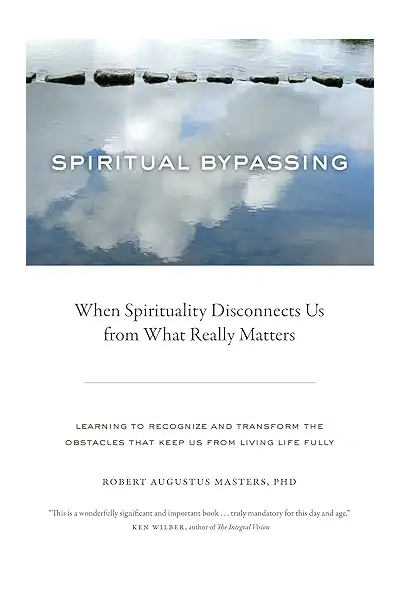
In "Spiritual Bypassing," Robert Augustus Masters names and dissects a phenomenon that anyone who has spent time in spiritual communities will recognize immediately: the use of spiritual ideas and practices to avoid confronting unresolved emotional wounds, psychological difficulties, and the messy, uncomfortable work of genuine human development. The term "spiritual bypassing" was originally coined by psychologist John Welwood in 1984, but Masters gives it its fullest, most clinically useful treatment, showing how this tendency pervades contemporary spiritual culture and why it matters so much for anyone serious about authentic growth.
Masters writes as both a psychotherapist and a longtime spiritual practitioner who has witnessed—and personally experienced—the seductive pull of using spiritual practice as a way to rise above pain rather than move through it. His critique isn't anti-spiritual. It's precisely the opposite: a passionate argument that spirituality is too important to be misused as an escape from the full spectrum of human experience. When we use meditation to dissociate from difficult emotions, when we invoke "forgiveness" to avoid feeling legitimate anger, when we retreat into "non-attachment" to sidestep the vulnerability of genuine intimacy, we aren't transcending our limitations. We're reinforcing them while adding a spiritual veneer that makes the avoidance harder to see. For IMHU's community, this book serves as an essential corrective—a reminder that the integration of spirituality and mental health requires emotional honesty and psychological depth, not spiritual platitudes layered over unexamined wounds.
Naming the Shadow of Spirituality
Masters identifies spiritual bypassing as a widespread and deeply entrenched pattern in which spiritual beliefs and practices are co-opted by the psyche's avoidance mechanisms. The forms are various and often subtle. There's the premature forgiveness that skips over the genuine processing of hurt and anger. There's the compulsive positivity that treats any negative emotion as evidence of insufficient spiritual development. There's the emotional detachment dressed up as equanimity. There's the tolerance of abusive behavior rationalized as acceptance or non-judgment. There's the obsessive focus on the transcendent that functions as a flight from the embodied, the relational, and the earthly.
What makes spiritual bypassing so insidious is that it mimics genuine spiritual development closely enough to fool both the practitioner and their community. The person who has "forgiven" their abuser looks, on the surface, like someone who has done deep spiritual work. But if that forgiveness was reached by leaping over the rage, grief, and violation that the abuse caused—rather than by moving through those feelings with full awareness—then it's not genuine forgiveness. It's dissociation with a spiritual label. Masters argues that this confusion between authentic spiritual maturity and its avoidant imitation is one of the most significant obstacles to genuine growth in contemporary spiritual culture. It keeps people comfortable and appearing evolved while their actual emotional wounds remain untouched, continuing to drive behavior from the shadows.
The Emotional Avoidance at the Core
At the heart of spiritual bypassing, Masters argues, is a fundamental unwillingness to feel. Not to think about feelings, not to observe feelings from a meditative distance, not to reframe feelings in spiritual terms—but to actually feel them in the body, with full vulnerability, without rushing toward resolution or meaning-making. This capacity for raw emotional experience is precisely what most spiritual bypassers lack, and their spiritual practice, rather than developing this capacity, has become a sophisticated strategy for avoiding it.
Masters is particularly incisive about how meditation traditions can inadvertently support this avoidance. A practitioner who has learned to observe emotions from the witness perspective can easily confuse emotional detachment with genuine equanimity. They can watch anger arise and pass without ever letting it fully inhabit their body, without letting it inform them about what matters to them, without letting it fuel appropriate action. They sit on their cushion, radiating calm, while their intimate relationships suffer, their boundaries remain porous, and their authentic self stays hidden beneath a persona of spiritual composure. The meditation practice becomes a technology for emotional regulation that bypasses the emotional processing it mimics. Masters insists that this isn't a problem with meditation itself but with how it's practiced when the practitioner's primary unconscious motivation is avoidance rather than genuine opening.
Spiritual Bypassing in Relationships
Some of Masters' most penetrating observations concern how spiritual bypassing plays out in intimate relationships—and how it can make those relationships superficially peaceful while preventing the genuine intimacy that requires vulnerability, conflict, and emotional honesty. Partners who are committed to spiritual bypassing often create a relational atmosphere in which anything negative is quickly reframed, rationalized, or transcended. Anger becomes "an opportunity for practice." Hurt becomes "a mirror for my own projections." Legitimate grievances become "attachments to let go of." The relationship looks harmonious from the outside while both partners are slowly starving for the kind of raw, emotionally honest contact that genuine intimacy requires.
Masters is particularly direct about how spiritual bypassing intersects with issues of power and abuse in spiritual communities. When a community's spiritual framework emphasizes acceptance, non-judgment, and surrender, those values can be weaponized to silence legitimate protest against harmful behavior. A student who confronts a teacher's abuse can be told they're "projecting," "in their ego," or "resisting surrender." A community member who expresses anger about being mistreated can be labeled as spiritually immature. The spiritual framework becomes a tool for maintaining harmful power dynamics while making it nearly impossible for victims to name what's happening. This dynamic has played out in spiritual community after spiritual community, and Masters argues that understanding spiritual bypassing is essential for preventing and addressing these patterns.
Shadow Work as Spiritual Practice
Masters' alternative to spiritual bypassing is what he calls "full-spectrum" spiritual practice—a practice that includes the shadow, the body, the emotions, and the relational field as essential dimensions of spiritual development rather than obstacles to transcend. Drawing on Jungian psychology, somatic therapy, and his own decades of therapeutic work, he argues that genuine spiritual maturation requires descending into the messy depths of human experience at least as much as ascending toward transcendent heights. The shadow—all those aspects of ourselves we've rejected, denied, or hidden—doesn't disappear when we meditate. It gets pushed further underground, where it drives behavior we can't see and creates patterns we can't change.
This integration of psychological shadow work and spiritual practice is central to what IMHU advocates for. Many people arrive at spiritual practice carrying significant unresolved trauma, and without psychological awareness, spiritual practice can reorganize the trauma rather than heal it. A person with developmental trauma who enters a tradition that emphasizes self-transcendence may use the teaching to reinforce their existing dissociative patterns—becoming very good at leaving their body and entering expanded states while remaining profoundly disconnected from their embodied emotional reality. Masters argues that the antidote is a practice that consciously includes what we'd rather exclude: the anger, the grief, the neediness, the jealousy, the fear—all the parts of our humanity that spiritual bypassing tries to leave behind. Real spiritual growth isn't about rising above our humanness. It's about becoming more fully, more consciously, more compassionately human.
Why This Matters for Integrating Spirituality and Mental Health
For anyone working at the intersection of spirituality and mental health—which is to say, for IMHU's entire community—Masters' work provides an indispensable diagnostic tool and a crucial warning. The integration of spiritual and psychological perspectives, which IMHU rightly advocates for, can go wrong in very specific ways if spiritual bypassing isn't understood and addressed. A clinician who incorporates spiritual perspectives without understanding how spirituality can be co-opted by avoidance may inadvertently support their client's bypassing patterns rather than helping them heal. A spiritual teacher who lacks psychological sophistication may confuse dissociation with enlightenment in their students. A person in crisis who turns to spiritual community may find their pain met with premature reassurance rather than genuine compassion.
Masters' work ensures that the conversation about spirituality and mental health stays honest. It insists that spirituality, to be genuinely healing, must include the capacity to face everything—not just the luminous and transcendent but also the dark, the painful, the shameful, and the broken. This is not a rejection of spiritual experience or practice. It's a demand that spiritual practice live up to its own highest aspirations by refusing to leave any part of human experience outside the circle of awareness. For IMHU, this means that advocating for the inclusion of spirituality in mental health care must always be accompanied by an equal insistence on psychological depth, emotional honesty, and the willingness to confront the ways spirituality itself can become a hiding place. The goal isn't spiritual comfort. It's spiritual integrity—and that requires the courage to feel everything, avoid nothing, and use our practice to become more whole rather than more cleverly defended.