


Summary
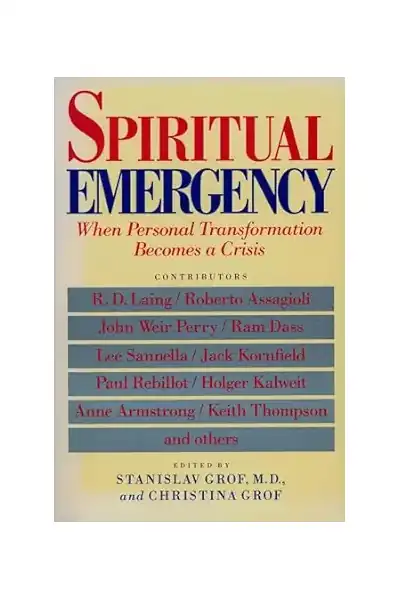
In "Spiritual Emergency: When Personal Transformation Becomes a Crisis," Stanislav and Christina Grof assembled what amounts to a founding document for one of the most important ideas in modern mental health: that some experiences currently diagnosed as psychotic breakdowns are actually breakthroughs, turbulent but ultimately healing processes of spiritual awakening that our psychiatric system is catastrophically unequipped to recognize. Published in 1989, this edited collection brought together a remarkable group of thinkers—transpersonal psychologists, psychiatrists, meditation teachers, and mythologists—to make a case that was radical then and remains urgent now. What if the line between madness and mystical experience isn't nearly as clear as we've been told?
The Grofs didn't arrive at this question theoretically. Christina's own devastating spiritual emergency, triggered by the birth of their first child, became the lived experience that drove the book into existence. Stanislav's decades of research with psychedelics and holotropic breathwork had shown him repeatedly that non-ordinary states of consciousness, when properly supported, could lead to profound healing and psychological integration. But when those same states erupted spontaneously, without context or support, the result was often a psychiatric diagnosis, heavy medication, and the effective suppression of a transformative process. This book was their attempt to change the conversation entirely, offering clinicians, families, and individuals in crisis a framework for understanding spiritual emergency not as something to be feared and medicated, but as something to be recognized and supported. For anyone connected to IMHU's mission, this is essential reading—the book that named the crisis and opened the door to a more humane response.
Defining Spiritual Emergency
The Grofs drew a crucial distinction that remains the backbone of this entire field: the difference between spiritual emergence and spiritual emergency. Spiritual emergence is the gradual, relatively smooth unfolding of spiritual awareness—the kind of growth that happens through years of meditation practice, prayer, or simply deepening into life's experiences. Spiritual emergency is what happens when that same process accelerates dramatically, overwhelming the individual's capacity to integrate what's happening. The symptoms can look alarmingly like psychosis: overwhelming visions, dissolution of the sense of self, inability to function in daily life, terror, ecstasy, or both at once.
What makes the Grofs' framework so important is the insistence that these two phenomena exist on a continuum rather than in separate categories. A spiritual emergency isn't a different kind of event from spiritual emergence—it's the same fundamental process happening too fast, too intensely, or without adequate support. This reframing has enormous implications for treatment. If you understand that someone is going through an accelerated transformative process rather than a disease, your entire approach changes. Instead of suppressing symptoms with medication, you create a safe container. Instead of treating the person as broken, you treat them as someone whose system is attempting a profound reorganization. The question shifts from "What's wrong with you?" to "What's trying to happen here, and how can we help it unfold safely?"
Varieties of Spiritual Emergency
One of the book's most valuable contributions is its taxonomy of spiritual emergency forms. The Grofs and their contributors identified several distinct patterns, each with its own phenomenology, challenges, and trajectory. Kundalini awakening involves intense energy sensations, involuntary movements, and overwhelming emotional states as dormant energy surges through the body's subtle channels. Shamanic crisis resembles the initiatory illness described across indigenous traditions, involving encounters with death and dismemberment, journeys through other realms, and eventual return with healing capacities. Past-life experiences flood consciousness with vivid memories of apparent previous incarnations. Psychic opening brings overwhelming sensitivity to others' thoughts and emotions. Near-death experiences reshape someone's entire relationship with mortality and meaning.
This mapping matters because it gives both clinicians and individuals a way to recognize what's happening without defaulting to pathology. When someone in the grip of a kundalini awakening shows up at an emergency room with uncontrollable body movements and visions of light, a clinician familiar with this framework can respond very differently than one who sees only psychomotor agitation and hallucinations. The person in crisis, too, benefits enormously from learning that their experience has a name, a pattern, and precedents in human history. There's an immense difference between thinking "I'm losing my mind" and understanding "I'm going through a recognized form of spiritual emergency that others have navigated successfully." That reframing alone can be therapeutic.
The Problem with Psychiatric Diagnosis
Running through the entire book is a pointed critique of mainstream psychiatry's inability—or unwillingness—to distinguish between genuine psychopathology and transformative spiritual crisis. The contributors argue that the diagnostic categories available to most clinicians simply don't have room for the possibility that some psychotic-looking experiences might be meaningful, purposeful, and ultimately healing. When the only tool you have is a diagnostic manual built on materialist assumptions about consciousness, every non-ordinary experience starts looking like a symptom to be eliminated.
The consequences of this diagnostic blindness are not abstract. They include real people being hospitalized against their will, medicated into numbness, and told that their most profound experiences are merely evidence of brain malfunction. The Grofs documented cases where individuals in the midst of genuine spiritual emergencies were treated with heavy antipsychotic medication that not only suppressed the acute crisis but appeared to block the completion of the transformative process, leaving people stuck in a kind of psychological no-man's-land—no longer in acute crisis but unable to integrate what had begun. Several contributors make the case that this interruption can cause more lasting psychological damage than the emergency itself. The book doesn't argue that all psychotic experiences are spiritual emergencies, but it insists that some are, and that the failure to tell the difference represents a serious ethical problem in mental health care.
Creating Supportive Environments
Perhaps the most practically useful section of the book concerns what actually helps someone in spiritual emergency. The Grofs' approach centered on creating what they called a "supportive environment"—a safe physical and relational container where the process could unfold without being prematurely shut down. This meant twenty-four-hour presence from trained sitters, a comfortable and non-clinical space, permission to express whatever was arising without judgment, and minimal use of medication. The emphasis was on staying with the person through the intensity rather than trying to make the intensity go away.
This approach required a fundamental shift in the helper's orientation. Instead of the clinician as expert who diagnoses and fixes, the model called for a companion who trusts the wisdom of the process itself. Helpers were trained to follow the person's experience rather than directing it, to offer reassurance without interpretation, and to maintain their own groundedness as an anchor for someone whose reality was temporarily destabilized. The Grofs drew explicitly on the midwifery model: just as a midwife supports a natural process rather than performing a medical procedure, the spiritual emergency helper supports an organic psychological transformation. This metaphor captures something essential about the approach. Birth is natural, but it can also be dangerous. It benefits enormously from skilled, calm support. The same is true for the kind of psychological death and rebirth that spiritual emergency often involves.
A Legacy Still Unfolding
More than three decades after its publication, "Spiritual Emergency" remains startlingly relevant—a testament to both the power of the Grofs' insight and the slowness of institutional change. The book catalyzed the creation of the Spiritual Emergence Network, which connected people in crisis with clinicians who understood non-ordinary states. It influenced the eventual inclusion of "Religious or Spiritual Problem" as a diagnostic category in the DSM-IV, a small but symbolically important acknowledgment that not all spiritual experiences are pathological. And it planted seeds that continue to bear fruit in the growing movement to integrate spiritual and transpersonal perspectives into mainstream mental health care.
Yet the core problem the book identified persists. Most psychiatric training still offers no framework for distinguishing spiritual emergency from psychosis. Most emergency rooms still default to medication and containment. Most insurance systems still won't cover the kind of extended, relationship-based support the Grofs advocated. In many ways, the mental health system's response to spiritual crisis has changed less than we might hope since 1989. This makes the book not just a historical document but a living challenge—an invitation that the field has only partially accepted. For IMHU, this text represents both a foundational reference and an unfinished project. The Grofs named something real and proposed something humane. The work of building systems that can actually deliver on their vision continues, and every reader who encounters this book becomes part of that ongoing effort.