


Summary
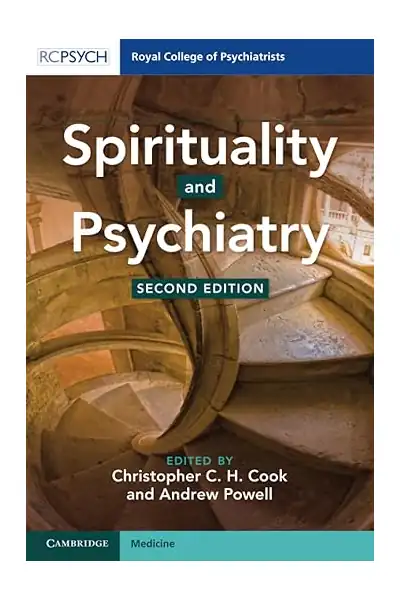
In "Spirituality and Psychiatry," Christopher C. H. Cook edits what amounts to a clinical handbook for a profession that has been largely flying blind when it comes to one of the most significant dimensions of its patients' lives. Published by the Royal College of Psychiatrists, this isn't a fringe text arguing from outside the establishment. It's the establishment itself acknowledging—carefully, methodically, and with full clinical rigor—that psychiatry's neglect of spirituality has been both scientifically unjustifiable and clinically harmful. Cook, a professor of both psychiatry and theology, brings together contributors who span the full range of clinical and academic expertise to create a resource that bridges the gap between what psychiatrists were trained to do and what their patients actually need.
What gives this book its particular weight is its tone. It doesn't rage against the psychiatric establishment or romanticize spiritual experience. Instead, it calmly and systematically makes the case that attending to patients' spiritual lives is simply good clinical practice—as essential as taking a family history or assessing for substance use. The contributors address assessment methods, ethical considerations, the relationship between spiritual experience and psychopathology, the role of chaplaincy, and the growing research base connecting spirituality to mental health outcomes. For clinicians, it provides practical tools. For patients who've felt their spiritual experiences were dismissed or pathologized, it provides validation from within the very system that dismissed them. For IMHU's community, it represents a crucial milestone: the moment mainstream British psychiatry officially acknowledged that the soul matters in the consulting room.
Why Psychiatry Lost Its Soul
Cook and his contributors trace how psychiatry came to exclude spirituality from its clinical gaze, and the story is more complicated than simple scientific materialism. The profession's roots in the nineteenth century actually included considerable engagement with religious and spiritual questions. Early asylum superintendents often saw moral and spiritual care as central to treatment. But as psychiatry sought legitimacy as a medical science—competing with neurology, aligning itself with the prestige of biological research—it progressively narrowed its focus to what could be measured, categorized, and treated pharmacologically. Spirituality, by its nature resistant to standardized measurement, fell outside the boundaries of what counted as clinically relevant.
Freud's influential hostility toward religion accelerated this exclusion within psychodynamic traditions, while the rise of biological psychiatry in the latter twentieth century completed it. The result was a profession that could map neurotransmitter pathways with extraordinary sophistication but had no language for talking about the experiences many patients considered most important: their sense of meaning, their relationship with the transcendent, their struggles with ultimate questions about suffering and existence. Cook argues that this wasn't an inevitable consequence of scientific progress. It was a choice—a culturally and historically specific decision about what matters in understanding human distress—and it's a choice the profession can revisit. The growing evidence base connecting spirituality to mental health outcomes makes revisiting it not just philosophically interesting but clinically necessary.
Assessment: Asking the Questions That Matter
One of the book's most practically valuable contributions is its guidance on spiritual assessment—how to ask about patients' spiritual lives in ways that are clinically useful without being intrusive, presumptuous, or tokenistic. The contributors acknowledge that many psychiatrists feel profoundly uncomfortable raising these questions. Some worry about imposing their own beliefs. Others fear they lack the expertise to engage meaningfully with spiritual material. Still others have internalized the profession's implicit message that spiritual concerns are irrelevant to clinical work and belong elsewhere—with chaplains, perhaps, or in the patient's private life.
The book challenges each of these objections. It provides specific frameworks for incorporating spiritual assessment into routine clinical practice, including questions about the role of faith or meaning in the patient's life, whether spiritual practices provide coping resources, whether spiritual or religious involvement has been a source of support or distress, and whether the patient has had experiences they would describe as spiritual or mystical. These questions aren't supplementary luxuries to be added when time permits. They're essential clinical information that can fundamentally alter the formulation and treatment plan. A patient whose depression is entangled with a crisis of faith needs something different from a patient whose depression is primarily biological. A patient whose voices are experienced as spiritually meaningful needs a different response than one whose voices are experienced as persecutory and distressing. You can't make these distinctions if you never ask the questions.
The Spiritual Experience–Psychopathology Boundary
The book devotes careful attention to what is arguably the most clinically challenging question in this entire field: how do you distinguish between spiritual experience and psychopathology when they can look so similar? Mystical states and psychotic states can both involve altered perception, unusual beliefs, dissolution of ordinary ego boundaries, and experiences that the person struggles to communicate in conventional language. A patient reporting contact with God, visions of light, or a profound sense of cosmic unity could be describing a peak mystical experience or the onset of a manic episode. Getting this wrong in either direction has serious consequences.
Rather than offering false certainty, the contributors lay out the clinical features that tend to distinguish healthy spiritual experience from psychopathological states. Broadly, spiritual experiences that occur in culturally recognized contexts, that the person can reflect on with some critical distance, that don't impair functioning or relationships, and that lead to increased wellbeing and personal growth are more likely to be genuine spiritual phenomena. Experiences that are ego-syntonic to the point of total absorption, that produce significant functional impairment, that are accompanied by other psychopathological features, or that leave the person more fragmented rather than more integrated warrant more clinical concern. But the contributors are honest that these guidelines don't always produce clear answers, and that clinicians need to develop a tolerance for ambiguity in this space. Sometimes the most responsible clinical position is acknowledging that you're not sure what's happening and creating conditions where the picture can become clearer over time.
Spirituality as a Resource for Recovery
The book assembles substantial evidence that spiritual and religious engagement frequently functions as a powerful resource in recovery from mental illness—a finding that makes psychiatry's historical neglect of this dimension even more difficult to justify. Studies across multiple populations and diagnoses show that spiritual practices, faith communities, and a sense of spiritual meaning are associated with better outcomes in depression, anxiety, substance use disorders, psychosis, and PTSD. People who feel connected to something larger than themselves, who have frameworks for making meaning of suffering, and who belong to communities organized around shared spiritual values tend to recover more fully and more durably than those who lack these resources.
This doesn't mean spirituality is a treatment in the pharmaceutical sense—something to be prescribed and dosed. But it does mean that clinicians who ignore or dismiss their patients' spiritual resources are effectively working with one hand tied behind their backs. The book advocates for a collaborative model in which psychiatric treatment and spiritual care work together rather than in separate silos. This might mean involving chaplains in multidisciplinary teams, supporting patients in accessing faith communities, incorporating mindfulness and contemplative practices into treatment programs, or simply acknowledging that a patient's prayer life or meditation practice is as relevant to their recovery as their medication compliance. The recovery movement's emphasis on hope, meaning, identity, and connectedness aligns naturally with spiritual frameworks, and the contributors argue that integrating these dimensions into psychiatric care isn't an optional extra—it's a clinical imperative.
A Profession Beginning to Change
The publication of this book by the Royal College of Psychiatrists represented something genuinely significant: the profession's primary institutional body in the UK officially endorsing the position that spirituality matters in psychiatric practice. The Spirituality and Psychiatry Special Interest Group, which Cook helped lead, has grown into one of the College's largest, suggesting that a substantial portion of working psychiatrists felt the need for a space to integrate these dimensions of their work. Similar developments have occurred in the American Psychiatric Association and the World Psychiatric Association, indicating a global shift in professional attitudes.
Yet Cook and his contributors are realistic about how far there is still to go. Institutional endorsement doesn't automatically translate into changed practice. Most psychiatric training programs still offer minimal education in spiritual assessment and care. Most clinical settings still operate within frameworks that have no place for spiritual concerns. Most research funding still flows toward biological and pharmacological approaches rather than studies of spirituality and mental health. The book functions simultaneously as a celebration of how far the conversation has come and a reminder of how much further it needs to go. For IMHU, it represents an important strategic asset: a rigorously clinical, institutionally credible text that validates the organization's core mission from within the psychiatric mainstream. When skeptics suggest that integrating spirituality into mental health care is unscientific or unprofessional, this book—published by one of the world's most respected psychiatric institutions—provides a powerful counter-argument.