


Summary
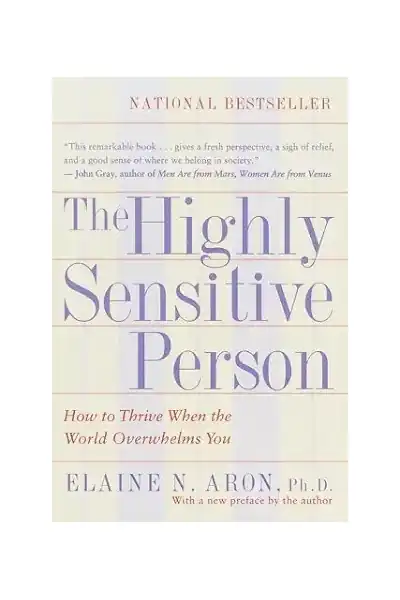
In "The Highly Sensitive Person," Elaine Aron—a research psychologist and psychotherapist—names and validates a trait that affects an estimated fifteen to twenty percent of the population and that has been systematically misunderstood by both the culture at large and the clinical professions that are supposed to help. High sensitivity, or Sensory Processing Sensitivity as Aron terms it in her research, is an innate temperamental trait characterized by deeper cognitive processing of stimuli, greater emotional reactivity, heightened awareness of subtleties in the environment, and a tendency toward overstimulation in intense or novel situations. It's not a disorder, not a weakness, and not something to be fixed. It's a fundamental variation in how nervous systems are organized—one that carries both significant gifts and real challenges.
The book matters for IMHU's community because high sensitivity intersects with spiritual experience in ways that are clinically significant and almost never discussed. Highly sensitive people are more likely to have intense spiritual experiences, more likely to be deeply affected by contemplative practices, more likely to experience what the Grofs call spiritual emergence, and more vulnerable to overwhelm when spiritual experiences occur without adequate support. They're also more likely to be misdiagnosed with anxiety disorders, depression, or personality disorders when their sensitivity is pathologized rather than understood. Aron's work provides an essential framework for distinguishing between sensitivity as a temperamental trait and sensitivity as a symptom of disorder—a distinction that has direct implications for how clinicians respond to people who present with intense inner experiences, emotional depth, and a porous boundary between self and world.
A Trait, Not a Disorder
Aron's foundational contribution is the demonstration, through rigorous research, that high sensitivity is an innate, biologically based temperamental trait found in approximately fifteen to twenty percent of humans and in over one hundred other species. This isn't a pathological condition that some unfortunate individuals develop. It's an evolutionary strategy—a way of processing information that has been preserved by natural selection because it confers survival advantages, particularly in environments where careful observation, awareness of threats, and responsiveness to social nuance are valuable. Sensitive individuals in any group tend to be the ones who notice danger first, who detect subtle changes in the social environment, and who process experience at deeper levels than the majority.
The clinical implications of recognizing sensitivity as a trait rather than a disorder are enormous. When a highly sensitive person seeks help because they're overwhelmed by stimulation, emotionally reactive to events that others seem to handle easily, or exhausted by the ordinary demands of a culture designed for less sensitive nervous systems, the appropriate response isn't to diagnose them with an anxiety disorder and prescribe medication. It's to help them understand their trait, develop strategies for managing stimulation, recognize their sensitivity's gifts alongside its challenges, and build a life that works with their nervous system rather than against it. The fact that mainstream clinical training includes virtually no education about high sensitivity means that misdiagnosis and inappropriate treatment are common—a problem that IMHU is positioned to help address.
The Biology of Deep Processing
Aron's research, supported by brain imaging studies conducted with her collaborators, reveals that highly sensitive people's brains literally process information differently. fMRI studies show greater activation in brain areas associated with awareness, empathy, integration of sensory information, and emotional processing. Sensitive brains don't just receive more stimulation—they process what they receive more deeply, making more connections, detecting more patterns, and generating more emotional and somatic responses to incoming experience. This deeper processing is the source of both the trait's gifts and its challenges.
The gifts include heightened creativity, emotional depth, empathic accuracy, aesthetic sensitivity, and the capacity for profound spiritual experience. The challenges include susceptibility to overstimulation, difficulty with transitions and change, emotional intensity that can be mistaken for instability, and a vulnerability to environments that are too loud, too fast, too demanding, or too emotionally chaotic. Aron emphasizes that the same processing depth that makes a sensitive person vulnerable to overwhelm also makes them capable of extraordinary richness of experience. They don't just feel more pain—they feel more beauty, more meaning, more connection, more awe. The clinical task isn't to dampen this processing but to help the person manage the flow so that the gifts can be accessed without the person drowning in stimulation they can't metabolize.
Sensitivity and the Wound of Not Belonging
Aron addresses with compassion the psychological wound that many highly sensitive people carry: the deep, often pre-verbal sense that something is fundamentally wrong with them. In a culture that values toughness, thick skin, extroversion, and rapid-fire stimulation processing, being a person who needs quiet, feels deeply, notices everything, and becomes overwhelmed in environments that others find normal feels like a deficiency. Sensitive children are told they're "too sensitive," "too emotional," "too intense." They learn to suppress their natural responses, to pretend they're unaffected, to push through overstimulation at the cost of their wellbeing. By adulthood, many sensitive people have internalized the message that their fundamental way of experiencing the world is flawed.
This wound has direct relevance for IMHU's work. Many of the people who seek out spiritual practice, who have spontaneous mystical experiences, or who present in clinical settings with intense inner lives that don't fit standard diagnostic categories are highly sensitive people. Their spiritual experiences may be more vivid, more frequent, and more destabilizing than those of less sensitive individuals—not because they're more disordered but because their nervous systems are wired for depth of processing. When clinicians don't understand high sensitivity, they're likely to pathologize these experiences. When they do understand it, they can help the person reframe their intensity not as evidence of brokenness but as evidence of a nervous system designed for the kind of deep engagement with life that many spiritual traditions consider the highest form of human development.
Practical Strategies for Sensitive Living
A significant portion of the book is devoted to practical strategies for managing life as a highly sensitive person, and these strategies have clinical value beyond the self-help context. Aron addresses stimulation management—learning to recognize one's arousal level and adjust environmental input before overwhelm sets in. She discusses the importance of adequate downtime and solitude for processing the day's accumulated stimulation. She explores how sensitivity affects intimate relationships, workplace dynamics, and health. And she provides frameworks for distinguishing between the challenges inherent in the trait itself and the additional difficulties created by growing up in a culture that pathologizes sensitivity.
These practical strategies become particularly relevant for sensitive people who are navigating spiritual experiences or contemplative practices. A highly sensitive person on a meditation retreat may be processing far more material than a less sensitive practitioner—emotional, somatic, and subtle-energetic information that can quickly become overwhelming without adequate self-regulation. A sensitive person experiencing a kundalini awakening or spontaneous mystical state may need more grounding support, more gradual pacing, and more attentive aftercare than someone with a less reactive nervous system. Understanding high sensitivity as a variable that affects how spiritual experiences unfold—how intense they are, how long they take to integrate, how much support the person needs—gives clinicians and spiritual guides a crucial piece of information for tailoring their responses to individual needs rather than applying one-size-fits-all approaches.
Sensitivity as a Gift for the World
Aron concludes with a broader perspective on what high sensitivity means not just for individuals but for communities and cultures. She argues that sensitive people serve essential functions in social groups: they're the ones who notice when something is wrong before others do, who feel the emotional undercurrents that others miss, who sense environmental threats that the majority overlooks, and who experience beauty and meaning at a depth that enriches the cultural life of their communities. A group composed entirely of non-sensitive members would miss crucial information. A group that includes sensitive members—and values their contributions—makes better decisions, responds more adaptively to change, and maintains a richer inner life.
This perspective reframes sensitivity from a personal challenge to be managed into a collective resource to be valued. For IMHU, this reframing has strategic significance. Many of the people drawn to IMHU's mission—people interested in the intersection of spirituality and mental health, people who have had intense spiritual experiences, people who feel that mainstream psychiatry has failed to understand them—are likely disproportionately highly sensitive. Understanding this population's specific needs, strengths, and vulnerabilities is essential for serving them well. Aron's work provides the foundation for that understanding, and it carries an implicit challenge to IMHU's community: to build spaces, practices, and support systems that honor sensitivity rather than requiring people to overcome it. The world doesn't need sensitive people to become less sensitive. It needs systems that can hold sensitivity wisely—and that includes mental health systems, spiritual communities, and organizations like IMHU that work at their intersection.