


Summary
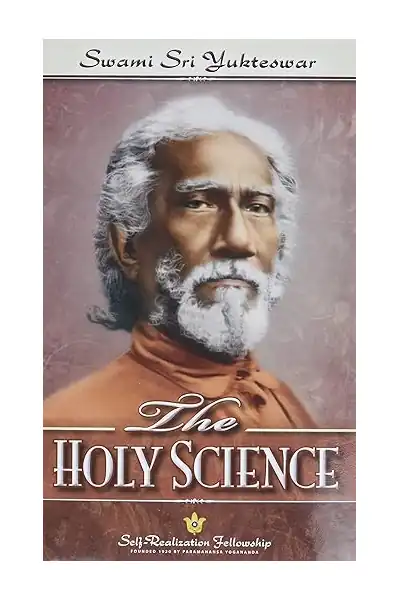
In 1894, at a sacred gathering at the Kumbha Mela in Allahabad, a young Indian scholar named Priya Nath Karar (later known as Swami Sri Yukteswar) had a conversation with the legendary yogi Mahavatar Babaji that would result in one of the most unusual spiritual texts ever written. Babaji observed that brilliant minds in Europe and America had become wedded to materialism, unable to recognize the essential unity underlying all religions. He asked Yukteswar to write a book that could bridge East and West, showing how the deepest truths of Christianity and Hinduism point to the same reality. The result was "The Holy Science," a compact, dense treatise that takes passages from the Bible (especially the Book of Revelation) and places them alongside Sanskrit sutras to demonstrate their fundamental harmony.
What makes this book remarkable isn't just its interfaith ambitions but its sheer conceptual compression. Written originally as Sanskrit sutras with commentary, it packs cosmology, spiritual psychology, practical ethics, and mystical theology into fewer than 100 pages. Yukteswar was no ordinary sage. Trained in mathematics, astronomy, astrology, and medicine, he brought a scientific precision to metaphysical questions. The book is divided into four sections mirroring stages of spiritual development: The Gospel (fundamental truths of creation), The Goal (what all beings seek: Existence, Consciousness, and Bliss), The Procedure (practical methods for realization), and The Revelation (states of consciousness available to those nearing enlightenment). Throughout, he weaves together Sankhya philosophy, Christian mysticism, yogic practice, and his own controversial theory about vast cosmic cycles (yugas) governing human consciousness. For Western readers encountering Eastern philosophy, or Eastern readers curious about Christianity's mystical core, this slim volume offers something genuinely bridging rather than merely comparative.
The Unity of Religious Truth
Yukteswar's foundational claim is that all great religions teach the same essential truths, but these truths have become obscured by sectarian additions, cultural interpretations, and institutional politics. He's not making a vague claim about all paths leading to the same mountaintop. He's arguing something more specific: that the core teachings of Christianity and Hinduism, when properly understood, describe the same spiritual cosmology, the same stages of consciousness development, the same practices for realization, and the same ultimate goal. To demonstrate this, he places biblical passages (particularly from Revelation, which he treats as a coded mystical text) alongside verses from the Upanishads and Bhagavad Gita, showing parallel structures and shared metaphysical frameworks.
The genius and audacity of this approach is that Yukteswar doesn't dilute either tradition to find common ground. He dives into the esoteric depths of both, suggesting that mystical Christianity and yogic Hinduism both understand reality as consciousness manifesting through descending stages of vibration into apparent materiality, with the spiritual path consisting of reversing that descent and returning awareness to its source. Where most interfaith dialogue settles for mutual respect and shared ethical values, Yukteswar goes for broke, claiming that the Bible's "throne of God" and the Hindu concept of Brahman point to the same transcendent reality, that the Christian "Holy Ghost" and the yogic Pranava (cosmic vibration, AUM) are identical, that John's vision in Revelation maps precisely onto the stages of consciousness described in Sankhya philosophy. Whether or not readers accept these equivalences, the book succeeds in demonstrating that religions may not be as fundamentally incompatible as modern secularism or religious fundamentalism both assume.
The Four Sections: A Spiritual Curriculum
The book's structure itself teaches. Yukteswar organizes his treatise around four stages of spiritual development, each corresponding to both a section of the book and a phase of the seeker's journey. The Gospel section establishes metaphysical foundations, explaining how the eternal, formless Spirit manifests as creation through the play of consciousness and nature (Purusha and Prakriti in Hindu terms), producing the visible universe we inhabit. This isn't abstract philosophy for Yukteswar. It's practical knowledge about reality's structure that every serious spiritual practitioner needs to understand.
The Goal section identifies what all beings fundamentally seek: Sat-Chit-Ananda (Existence-Consciousness-Bliss in Sanskrit, which Yukteswar shows parallels the Christian Trinity). All human striving, he argues, ultimately aims at these three, though most people pursue them through external means that can never satisfy. The Procedure section gets practical, outlining the actual disciplines required for spiritual progress: right understanding, right action, right devotion, and right meditation. He describes natural living practices for bodily and mental purity, ethical guidelines, methods of concentration, and the inner work of transcending identification with the limited ego-self. The final section, Revelation, describes the extraordinary states of consciousness that become available as one progresses along this path, states where the ordinary boundaries of self dissolve and direct perception of spiritual realities becomes possible. By structuring the book this way, Yukteswar creates a complete spiritual curriculum, from cosmological understanding through practical method to ultimate realization.
The Controversial Yuga Cycle Theory
Perhaps the most contentious aspect of "The Holy Science" is Yukteswar's radical reinterpretation of the Yuga cycles, the vast epochs described in Hindu cosmology that govern the rise and fall of human consciousness. Traditional Hindu scholars believe we're currently in Kali Yuga, the darkest age of ignorance and materialism, which they calculate will last hundreds of thousands of years. Yukteswar completely rejects these calculations, arguing that errors in astronomical understanding led to a massive inflation of the cycle lengths. He proposes instead that we're in ascending Dwapara Yuga, an age of energy and awakening.
His model is elegant: a complete cycle lasts 24,000 years (corresponding to the precession of the equinoxes), divided into descending and ascending arcs. As consciousness descends through the yugas (Satya, Treta, Dwapara, Kali), human civilization loses spiritual awareness and becomes increasingly materialistic. Then the process reverses, with consciousness ascending back through the same stages. The lowest point was around 500 CE (roughly corresponding to the Dark Ages in Europe). Since then, we've been climbing out of Kali Yuga (which lasted only 1,200 years in his model, not hundreds of thousands). We entered ascending Dwapara Yuga in 1699, which Yukteswar suggests explains the explosion of scientific understanding, technological advancement, and rediscovery of energy (electricity, atomic power) in modern times. While many traditional scholars reject this revision, it has proven influential, offering a more optimistic reading of human potential than the idea that we're stuck in darkness for eons. Whether accurate or not, Yukteswar's yuga theory reflects his broader conviction that spiritual evolution is real, measurable, and tied to cosmic cycles beyond individual lifetimes.
Practical Spirituality, Not Mere Philosophy
Despite its dense metaphysical content, "The Holy Science" never loses sight of practical application. Yukteswar wasn't writing for scholars or theologians but for sincere seekers wanting to actually realize spiritual truths in their own experience. The Procedure section grounds everything in specific practices: natural diet, pure living, cultivation of virtues, development of concentration, and ultimately the practice of meditation techniques (particularly Kriya Yoga, though the book doesn't go into detailed instruction) that allow direct perception of spiritual realities.
Yukteswar understood something that many spiritual teachers miss: intellectual understanding alone changes nothing. You can know all about the unity of religions, understand every cosmological system, memorize every sutra, and still be completely trapped in ego and ignorance. What matters is transformation of consciousness through sustained practice. The book emphasizes the necessity of a living guru, someone who has walked the path and can guide others through its challenges and pitfalls. Knowledge transmitted through books and institutions, however valuable, can never replace the direct transmission that occurs in the guru-disciple relationship. This emphasis on lived practice over mere belief makes the book feel less like theology and more like an instruction manual, albeit one that requires dedication and willingness to actually do the work rather than just think about it.
A Bridge Between Worlds
"The Holy Science" remains relevant precisely because the problem Mahavatar Babaji identified in 1894 has only intensified. The gulf between religious traditions continues to divide humanity, often violently. Meanwhile, scientific materialism offers no satisfying answers to questions of meaning, purpose, or consciousness. Yukteswar's book suggests a third way: rigorous spiritual investigation that doesn't require abandoning either reason or direct experience, that respects both scientific inquiry and mystical insight, that finds common ground between traditions without flattening their distinctive wisdom.
The book's influence extends beyond its relatively small readership. Yukteswar trained Paramahansa Yogananda, who went on to write "Autobiography of a Yogi" and introduce millions of Westerners to yoga and meditation. The interfaith approach modeled in "The Holy Science" helped create cultural space for spiritual seekers who feel drawn to multiple traditions or who find themselves unable to commit to any single religious framework. More fundamentally, the book models a kind of spiritual seriousness that contemporary culture often lacks. It treats spiritual realization not as a weekend workshop experience or a feel-good philosophy but as the highest purpose of human existence, something worth organizing one's entire life around. Whether readers accept Yukteswar's specific claims about scriptural equivalences or yuga cycles matters less than whether they catch his conviction that truth is real, knowable through direct experience, and worth any sacrifice required to attain it. In an age of spiritual tourism and superficial syncretism, "The Holy Science" offers something rarer: genuine depth and a complete path for those willing to walk it.