


Summary
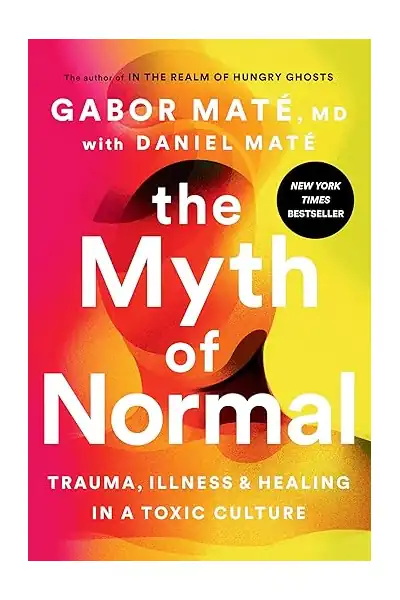
In "The Myth of Normal," Gabor Maté delivers what may be his most ambitious and comprehensive work: a sweeping indictment of Western culture's capacity to generate illness while calling the result "normal." Maté, a physician whose previous books on addiction, attention deficit disorder, and the mind-body connection have made him one of the most influential voices in integrative health, argues that the epidemic levels of chronic illness, mental health disorders, and addiction in modern societies aren't aberrations. They're the predictable consequences of a culture organized around values—disconnection, competition, materialism, suppression of emotion—that systematically violate the conditions human beings need to thrive. What we call "normal" isn't health. It's a culturally sanctioned form of dysfunction that we've stopped being able to see because we're all immersed in it.
The book weaves together developmental science, trauma research, immunology, psychoneuroendocrinology, and Maté's decades of clinical experience into a unified argument that the split between mind and body, between individual and environment, between psychological suffering and physical disease is artificial and harmful. Illness doesn't arise randomly. It develops in bodies shaped by attachment experiences, emotional patterns, social conditions, and cultural pressures that we rarely examine because they constitute the water we swim in. For IMHU's community, Maté's work provides a powerful scientific foundation for understanding why a culture that has severed the connection between body, mind, and spirit produces so much suffering—and why genuine healing requires addressing all three dimensions simultaneously rather than treating them as separate domains managed by separate professions.
What We Call Normal Is Making Us Sick
Maté's central thesis is that Western culture's definition of "normal" is itself pathological. We consider it normal for people to suppress their emotions to function in workplaces. We consider it normal for parents to return to work weeks after giving birth. We consider it normal for children to spend their days in institutional settings separated from their primary attachment figures. We consider it normal for people to be chronically stressed, sleep-deprived, and disconnected from their bodies. We consider it normal for elderly people to die alone in facilities rather than surrounded by family and community. Each of these "normal" conditions violates what developmental science, attachment research, and basic biology tell us human beings need to be healthy.
The cumulative effect of living within these conditions isn't just psychological discomfort. It's measurable physiological damage. Chronic emotional suppression alters immune function. Early attachment disruption shapes the stress-response system for life. Social isolation increases inflammation and accelerates aging. The body keeps score, as Bessel van der Kolk's complementary work demonstrates, and what it's scoring is the ongoing cost of living in a culture that treats its members' deepest biological and emotional needs as inconvenient obstacles to productivity. Maté argues that until we recognize that our "normal" cultural conditions are generating disease on a mass scale, we'll continue treating the symptoms while ignoring the cause—prescribing medications for the stress-related illnesses produced by a stressful culture, therapizing the anxiety generated by an anxiety-generating social system, and never asking the obvious question: what if the sickness isn't in the individual but in the culture itself?
Trauma as the Hidden Driver
Maté builds on and extends his earlier work on trauma to argue that unresolved trauma—and he defines trauma broadly, encompassing not just catastrophic events but the ongoing absence of what children need for healthy development—is the hidden thread connecting most chronic illness, mental health disorders, and addictive behaviors. The Adverse Childhood Experiences (ACE) research demonstrated decades ago that childhood adversity predicts adult disease with remarkable specificity and dose-response consistency. Maté goes further, arguing that even experiences not typically recognized as traumatic—emotional neglect, parental stress and distraction, the early suppression of authentic self-expression—shape the developing nervous system in ways that create lifelong vulnerability to both physical and psychological illness.
The mechanism Maté describes isn't mysterious. Early relational experience calibrates the stress-response system, shapes the immune system, programs inflammatory pathways, and establishes the emotional regulation patterns that will either protect or undermine health across the lifespan. A child whose emotional needs are consistently met develops a nervous system that can regulate stress effectively, an immune system that functions optimally, and a relationship with their own emotions that allows them to process experience rather than suppress it. A child whose needs aren't met—not necessarily through abuse but through the ordinary failures of stressed, distracted, traumatized parents operating within a culture that doesn't support the conditions children need—develops a nervous system biased toward threat detection, an immune system prone to either over- or under-reaction, and a pattern of emotional suppression that will eventually exact a physical toll. The implications are staggering: much of what we treat as individual disease may be, at root, the biological legacy of inadequate early relational environments—environments that our culture produces as a matter of course.
The Mind-Body Unity
One of Maté's most important contributions is his systematic dismantling of the mind-body split that still dominates Western medicine. He presents extensive evidence that emotional patterns and physical disease are not separate phenomena that sometimes happen to coincide but are expressions of the same underlying process. The autoimmune patient who spent a lifetime suppressing anger to maintain relationships. The cancer patient whose compulsive caregiving left no room for attending to their own needs. The heart disease patient whose driven, self-sacrificing work ethic was rooted in a childhood need to earn love through performance. These aren't coincidences or anecdotes. They're patterns that appear in the research with enough consistency to demand a unified model of how emotional life and physical health interact.
Maté draws on psychoneuroimmunology—the study of how psychological processes influence the nervous and immune systems—to provide the scientific framework for this unity. Chronic emotional suppression, particularly the suppression of so-called "negative" emotions like anger and sadness, measurably impairs immune function. The personality patterns most strongly associated with disease—compulsive self-sacrifice, emotional repression, inability to say no, excessive concern with meeting others' expectations—are precisely the patterns that a culture organized around productivity and compliance systematically reinforces. We train people to suppress their authentic emotional responses, reward them for doing so, and then act surprised when their bodies break down. Maté's analysis suggests that the epidemic of autoimmune disease, cancer, and other chronic conditions in affluent societies may be substantially a consequence of cultural conditions that require people to betray their own emotional truth as a condition of social belonging.
Authenticity as a Health Requirement
Running through the entire book is a concept that Maté considers central to both health and healing: authenticity. He defines authenticity not as a personality trait or a lifestyle brand but as the capacity to know and express one's genuine feelings, to maintain connection with one's own emotional truth, and to act from that truth even when doing so creates conflict with social expectations. Authenticity, in Maté's framework, is a biological necessity. The body requires genuine emotional expression the way it requires adequate nutrition—and the chronic suppression of authentic selfhood produces physiological consequences as real as those of chronic malnutrition.
The problem is that authenticity and attachment—the other fundamental human need—often conflict, particularly in childhood. A child who senses that expressing anger will threaten their connection with a caregiver learns to suppress anger. A child who discovers that being sad makes a parent uncomfortable learns to perform happiness. A child who finds that their authentic impulses are met with disapproval learns to construct a false self that will be accepted. These adaptations are survival strategies that protect attachment at the cost of authenticity. They work in childhood, but they create long-term health consequences as the suppressed emotional energy finds expression through the body instead. Maté argues that healing—from addiction, from chronic illness, from mental health disorders—fundamentally requires recovering the authenticity that was sacrificed in childhood. This isn't just psychological advice. It's a medical recommendation grounded in the biology of how emotional suppression damages physical health.
A Vision of Genuine Healing
Maté's prescriptions for healing are as sweeping as his diagnosis. If illness is generated by cultural conditions that violate human needs, then genuine healing must address those conditions—not just medicate their consequences. This means clinical practices that treat the whole person rather than isolated symptoms, that ask about childhood experience and emotional patterns as standard parts of medical assessment, that recognize the role of meaning, connection, and authentic self-expression in recovery. It means social policies that support the conditions families need to provide secure attachment—parental leave, economic security, community support for caregivers. It means a cultural shift away from the values of productivity, competition, and emotional suppression toward values of connection, authenticity, and mutual care.
For IMHU's community, Maté's work converges with the organization's mission at virtually every point. His insistence that health cannot be understood apart from the emotional, relational, and cultural contexts in which it develops parallels IMHU's insistence that mental health cannot be understood apart from its spiritual dimensions. His critique of a medical system that fragments the human being into isolated organ systems and chemical imbalances mirrors IMHU's critique of a psychiatric system that separates the psyche from the soul. And his vision of healing as a process of recovering wholeness—of reintegrating mind and body, self and other, individual and community—resonates with spiritual traditions that have always understood healing as a return to the fundamental unity that illness obscures. Maté doesn't use explicitly spiritual language throughout the book, but his analysis points inexorably toward a conclusion that is, at its core, a spiritual one: that human beings are whole creatures whose health depends on living in alignment with their deepest nature, and that a culture which prevents this alignment will produce epidemic suffering regardless of how sophisticated its medical technology becomes.