


Summary
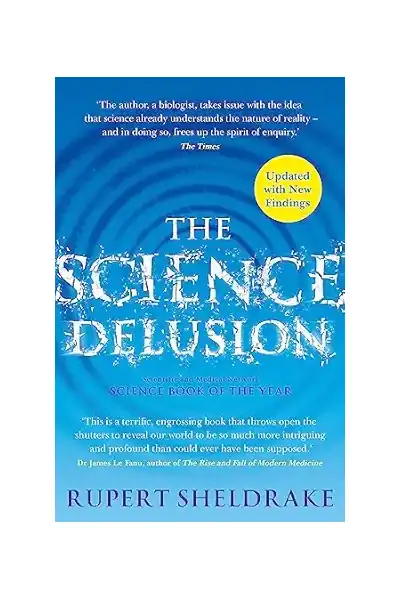
In "The Science Delusion" (published in the US as "Science Set Free"), Rupert Sheldrake takes aim at something most scientists consider beyond question: the philosophical assumptions that underpin modern science itself. His target isn't science as a method of inquiry—he's a trained biologist with a PhD from Cambridge and years of research at the Royal Society—but rather what he calls the "materialist worldview" that has hardened from a productive working hypothesis into an unexamined dogma. The core claim is provocative and precisely argued: science, which prides itself on questioning everything, has exempted its own foundational beliefs from scrutiny, and this exemption is constraining what science can discover.
Sheldrake identifies ten assumptions that he argues mainstream science treats as established facts rather than testable hypotheses: that nature is mechanical, that matter is unconscious, that the laws of nature are fixed, that the total amount of matter and energy is constant, that nature is purposeless, that biological inheritance is material, that memories are stored as material traces, that the mind is confined to the brain, that psychic phenomena are illusory, and that mechanistic medicine is the only kind that really works. He then systematically examines the evidence for each, finding it far more equivocal than the scientific consensus suggests. For IMHU's community, this book is foundational because it challenges the very framework within which spiritual and non-ordinary experiences get dismissed as impossible before they're even investigated. If Sheldrake is right that these assumptions are beliefs rather than established facts, then the door opens to a much wider understanding of consciousness, healing, and human experience.
Dogma Disguised as Knowledge
Sheldrake's central and most controversial claim is that science has developed its own form of fundamentalism. Just as religious fundamentalists treat certain beliefs as beyond question, scientific materialists treat the assumptions of their worldview as settled truths rather than working hypotheses. Try suggesting to a roomful of neuroscientists that consciousness might not be produced by the brain, and you'll experience something that looks less like scientific open-mindedness and more like the defensive reaction of believers whose faith has been challenged. The evidence doesn't warrant the certainty, Sheldrake argues, but the certainty persists because it has become part of the culture of science rather than a conclusion of scientific inquiry.
This distinction between science as a method and science as a belief system is crucial. The scientific method—forming hypotheses, testing them against evidence, revising them when the evidence demands it—is one of humanity's greatest intellectual achievements. Sheldrake isn't attacking this method. He's attacking the materialist philosophy that has attached itself to the method and that now determines which questions are considered legitimate, which phenomena are taken seriously, and which researchers receive funding and career advancement. When a set of assumptions becomes so entrenched that questioning them is treated as evidence of intellectual deficiency rather than intellectual courage, those assumptions have stopped being scientific and have become ideological. This is the "delusion" of the title: not that science is deluded in its methods, but that it has confused its philosophical commitments with its empirical findings.
Consciousness and the Hard Problem
Among the ten assumptions Sheldrake examines, the claim that consciousness is nothing but brain activity is perhaps the most consequential for IMHU's concerns. Mainstream neuroscience proceeds as if it's only a matter of time before consciousness is fully explained in terms of neural correlates and brain mechanisms. The "hard problem" of consciousness—how and why physical processes give rise to subjective experience—is acknowledged as unresolved but generally treated as a puzzle that will yield to more sophisticated brain imaging and computational models rather than as evidence that the materialist framework itself might be inadequate.
Sheldrake marshals evidence suggesting that this confidence may be misplaced. He examines research on near-death experiences, in which patients report detailed perceptions during periods of clinical death when their brains showed no measurable activity. He reviews studies on terminal lucidity, where patients with severely damaged brains suddenly become coherent and present shortly before death. He considers evidence for telepathy, precognition, and other phenomena that, if genuine, would be impossible under the assumption that mind is confined to brain. His point isn't that any single piece of evidence conclusively disproves the materialist model of consciousness. It's that the cumulative weight of anomalous evidence deserves serious investigation rather than reflexive dismissal, and that the scientific community's unwillingness to engage with this evidence looks less like principled skepticism and more like motivated avoidance of data that threatens a cherished worldview.
The Hypothesis of Morphic Resonance
Sheldrake is perhaps best known for his hypothesis of morphic resonance—the idea that nature operates through habits rather than fixed laws, and that organisms are shaped not just by their genes but by a kind of collective memory within their species. According to this hypothesis, when a sufficient number of individuals within a species learn a new behavior or develop a new form, it becomes easier for other members of the species to do the same, even without direct contact or genetic transmission. The "laws" of nature, in this view, are more like deeply ingrained habits that have evolved over time and could, in principle, continue to evolve.
This is the aspect of Sheldrake's work that provokes the most intense resistance from mainstream scientists, and it's worth understanding why. If morphic resonance is real, it implies a form of non-local connection between organisms that has no mechanism within current physics. It suggests that memory and information can be transmitted through fields rather than material structures. It challenges the foundational assumption that all causation in nature is mechanical and local. These implications are so far outside the current scientific paradigm that many scientists dismiss the hypothesis without examining the evidence Sheldrake offers in its support. Whether or not morphic resonance ultimately proves correct, the scientific community's response to it illustrates exactly the kind of dogmatic thinking Sheldrake is criticizing: an idea is rejected not because the evidence has been weighed and found wanting, but because its implications are incompatible with assumptions that are treated as non-negotiable.
Implications for Medicine and Healing
Sheldrake's tenth dogma—that mechanistic medicine is the only kind that works—has direct implications for how we understand healing and therapeutic approaches that fall outside the biomedical model. If consciousness is indeed confined to the brain and all causation is mechanical, then practices like energy healing, prayer, acupuncture, and shamanic medicine can only work through placebo effects or unrecognized mechanical pathways. But if consciousness is more fundamental than current science assumes, and if organisms are connected through fields and resonances that materialist science doesn't recognize, then a much wider range of healing modalities becomes theoretically plausible.
Sheldrake doesn't claim to have proven that any particular alternative healing practice works. What he does is challenge the a priori reasoning that declares these practices impossible before investigating them. This distinction matters enormously for people whose healing journeys have included spiritual, energetic, or transpersonal dimensions. Under the materialist framework, their experiences must be illusory or reducible to known mechanisms. Under a more open framework, their experiences might be pointing toward aspects of reality that science hasn't yet learned to investigate. For clinicians working with clients who report healing through meditation, prayer, ceremony, or other spiritual practices, Sheldrake's work provides intellectual permission to take these reports seriously rather than explaining them away—not as a substitute for evidence, but as a motivation for conducting the research that the materialist paradigm has effectively prevented.
The Freedom to Inquire
The deepest message of "The Science Delusion" isn't about any particular scientific claim. It's about intellectual freedom—the freedom to follow evidence wherever it leads, to ask questions that current paradigms consider illegitimate, and to take seriously phenomena that the dominant worldview insists are impossible. Sheldrake argues that science at its best embodies this freedom, and that the materialist orthodoxy that currently dominates scientific institutions represents a betrayal of science's own highest values. When young researchers avoid studying consciousness, psychic phenomena, or non-mechanistic healing because they know it would damage their careers, science has a problem that no amount of funding or technology can solve.
This message resonated powerfully enough to make Sheldrake's 2013 TEDx talk one of the most viewed and debated in the platform's history—and its subsequent removal by TED, under pressure from skeptic organizations, became its own demonstration of the institutional gatekeeping he describes. For IMHU, Sheldrake's work is strategically important because it challenges the intellectual framework that most commonly used to dismiss the organization's mission. The claim that spiritual experiences are "just" brain activity, that consciousness is "nothing but" neural computation, that non-ordinary states are "merely" pathological—these claims rest on philosophical assumptions, not established facts. By exposing these assumptions and inviting genuinely open inquiry, Sheldrake creates space for the kind of investigation into consciousness, spirituality, and healing that IMHU advocates for. The invitation isn't to abandon science but to practice it more courageously, more honestly, and with fewer predetermined conclusions about what we're allowed to find.