


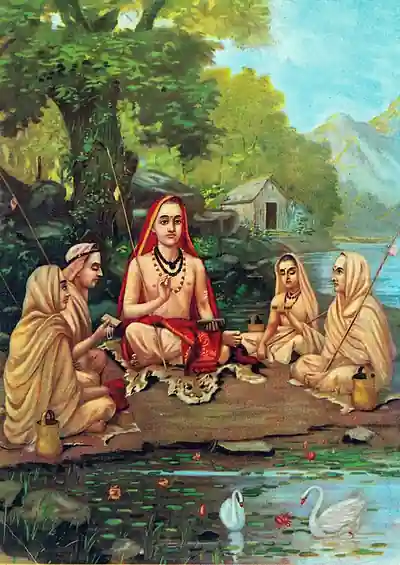
Who Is Adi Shankaracharya
Adi Shankaracharya (c. 788–820 CE) was an Indian philosopher, theologian, and religious reformer who is widely regarded as the most influential systematizer of Advaita Vedanta—the nondual school of Hindu philosophy. Despite dying around the age of 32, he produced an extraordinary body of philosophical commentary, established four major monastic centers (mathas) across India that continue to operate today, and consolidated a philosophical vision that has shaped Indian thought for over a millennium.
His relevance to IMHU's mission lies in the radical simplicity and psychological depth of his central claim: that the individual self (Atman) and ultimate reality (Brahman) are identical, and that the experience of separation—between self and world, self and other, self and the divine—is a fundamental misperception (maya/avidya). This framework provides one of the most coherent philosophical accounts of what mystics across traditions report: the dissolution of boundaries, the experience of unity, and the recognition that one's deepest identity is consciousness itself. For clinicians working with clients who report such experiences, Shankara's system offers a rigorous intellectual context that can help distinguish transformative insight from pathological dissociation.
Core Concepts
- Advaita (nonduality): Shankara's foundational teaching is that there is ultimately only one reality—Brahman—which is pure consciousness, infinite, and without qualities. Everything that appears as separate, multiple, or material is a superimposition on this single reality, much as a rope mistaken for a snake in dim light. The snake is never real; only the rope is. This isn't metaphor for Shankara—it's the literal structure of reality. The practical implication is that the suffering caused by feeling separate, isolated, or fundamentally alone is based on a misunderstanding that can, in principle, be corrected.
- Maya and avidya (illusion and ignorance): Maya is the cosmic principle that makes the one appear as many; avidya is the individual ignorance that makes you believe you are a separate, limited self. Shankara doesn't deny that the world appears—he denies that it has independent, ultimate reality. This distinction matters clinically: many people in spiritual crisis report that "the world feels unreal" or "I don't know who I am anymore." Shankara's framework suggests these experiences may represent the beginning of genuine insight rather than the onset of depersonalization disorder—though careful discernment is needed.
- The three states of consciousness: Shankara analyzed waking, dreaming, and deep sleep as evidence for his position. In deep sleep, the individual self disappears entirely, yet something persists—a witness awareness that is present in all three states but identified with none of them. This "fourth" state (turiya) is what you actually are. This analysis anticipates modern consciousness research questions about the relationship between awareness and its contents.
- Neti neti ("not this, not this"): The classical Vedantic method of self-inquiry: systematically recognizing that you are not your body, not your thoughts, not your emotions, not your roles—until what remains is pure awareness itself. This practice maps remarkably well onto certain meditation techniques and therapeutic approaches that help clients dis-identify from limiting self-concepts.
- Jnana yoga (the path of knowledge): While Shankara acknowledged devotional and action-based paths, he argued that only direct knowledge (jnana)—the immediate recognition of one's identity with Brahman—leads to final liberation. This isn't intellectual knowledge but a radical shift in the way reality is perceived, closer to what contemporary researchers call a "mystical experience" or "ego dissolution."
Essential Writings
- Vivekachudamani (Crest-Jewel of Discrimination): The most accessible introduction to Shankara's thought. A dialogue between a teacher and student that walks through the entire Advaita path from initial disillusionment to final realization. Best use: the place to start if you want to understand nondual philosophy from its most rigorous Hindu source.
- Atma Bodha (Self-Knowledge): A short, concentrated text of 68 verses laying out the core teaching: you are not the body-mind complex; you are the awareness in which all experience appears. Best use: a meditation companion—each verse is dense enough to contemplate for days.
- Upadeshasahasri (A Thousand Teachings): Shankara's most important original work (as distinct from his commentaries), containing both prose and verse sections on the method of teaching Advaita. Best use: for those who want to understand how Shankara actually transmitted his insights, not just what the insights were.
- Commentaries on the Brahma Sutras, Upanishads, and Bhagavad Gita: The scholarly foundation of the Advaita tradition. Shankara's commentaries on these three texts (the "triple canon" or prasthanatraya) established the philosophical arguments that subsequent Advaita teachers have built upon for centuries. Best use: for serious students who want the full philosophical architecture.