


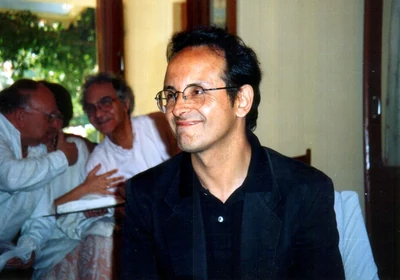
Who Is Francisco J. Varela
Francisco J. Varela (1946–2001) was a Chilean biologist, neuroscientist, and philosopher who made foundational contributions to the understanding of how living systems organize themselves and how consciousness emerges from the interplay of brain, body, and environment. Together with his mentor Humberto Maturana, Varela co-developed the concept of autopoiesis—the idea that living systems are self-creating, self-maintaining organizations—and later pioneered neurophenomenology, a research program that insists first-person experience must be integrated with third-person neuroscience to understand consciousness. (Wikipedia)
Varela’s significance is profound and multidimensional. He challenged the dominant view in cognitive science that the mind is essentially a computer processing representations of the world, proposing instead that cognition is “enactive”—it arises through the organism’s active engagement with its environment. He was also a serious practitioner of Tibetan Buddhism, and his contemplative practice deeply informed his scientific work. He argued that the contemplative traditions have developed sophisticated methods for investigating first-person experience that are essential for a complete science of mind. His founding of the Mind and Life Institute—which fosters dialogue between science and Buddhism—created one of the most productive interdisciplinary bridges in contemporary consciousness studies.
Core Concepts
- Autopoiesis: life as self-creation
- With Maturana, Varela proposed that living systems are defined by their capacity to continually produce and maintain themselves. This concept reframes biology from a mechanistic to an organizational perspective: what matters is not the specific components of a living system but the pattern of organization that maintains the system as a coherent whole.
- Enactive cognition
- Varela’s enactive approach to cognitive science holds that cognition is not representation but action—the organism and its environment co-create each other through ongoing interaction. Mind is not located in the brain alone but in the dynamic relationship between organism and world. This framework has profound implications for understanding perception, emotion, and consciousness.
- Neurophenomenology: bridging first-person and third-person science
- Varela argued that neuroscience alone cannot explain consciousness because it studies only the third-person, objective correlates of experience while ignoring the first-person, subjective dimension. Neurophenomenology proposes that trained first-person observation of experience—drawing on contemplative practices—must be integrated with neuroscientific data to create a complete science of consciousness.
- Science and contemplation as complementary paths
- As a practicing Buddhist and a world-class scientist, Varela embodied the integration of contemplative wisdom and scientific rigor. His work with the Dalai Lama and the Mind and Life Institute demonstrated that this integration is not merely possible but necessary for a full understanding of the mind.
Essential Writings
- The Embodied Mind: Cognitive Science and Human Experience (with Evan Thompson and Eleanor Rosch, 1991): A landmark work proposing the enactive approach to cognitive science and arguing for the integration of phenomenological and contemplative methods into the study of mind. Best use: the foundational text for anyone interested in how embodied, enactive, and contemplative perspectives can transform cognitive science.
- The Tree of Knowledge: The Biological Roots of Human Understanding (with Humberto Maturana, 1987): An accessible introduction to autopoiesis and the biology of cognition. Best use: the best starting point for understanding how life and mind are connected at the deepest level.
Image Attribution
“Francisco Varela.jpg” (photo: Joan Halifax), via Wikimedia Commons, licensed CC BY 2.0. Link: https://commons.wikimedia.org/wiki/File%3AFrancisco_Varela.jpg