


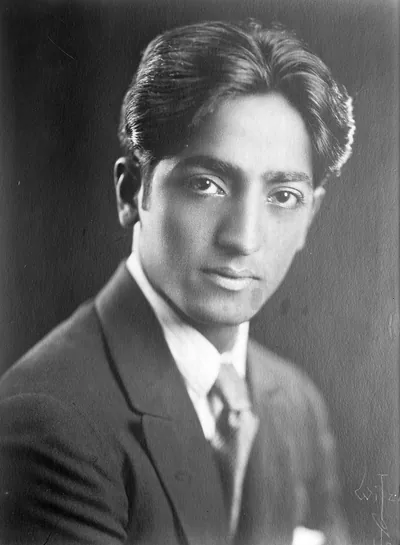
Who Is Jiddu Krishnamurti
Jiddu Krishnamurti (1895–1986) was an Indian-born philosopher, speaker, and spiritual teacher whose seven decades of public teaching defied every conventional category. As a boy in colonial India, he was "discovered" by leaders of the Theosophical Society, who believed he was destined to be a World Teacher—a messianic vehicle for a new era of human consciousness. He was educated in England, groomed for this role, and placed at the head of the Order of the Star in the East, an organization of thousands of devoted followers. Then, in 1929, in one of the most remarkable acts in modern spiritual history, he dissolved the organization, returned its assets, and declared: "Truth is a pathless land. You cannot approach it by any path whatsoever, by any religion, by any sect." He spent the remaining fifty-seven years of his life traveling the world, giving talks, and engaging in dialogues—all aimed at helping people see for themselves, without the mediation of authority, tradition, or method. (Wikipedia)
Krishnamurti’s relevance to IMHU’s mission is paradoxical and essential. He rejected every framework—psychological, spiritual, scientific—that claims to capture or organize truth, and he was deeply suspicious of the guru-student relationship, organized religion, and even meditation techniques (as typically practiced). Yet his relentless investigation of how the mind creates and maintains suffering through thought, memory, identification, and psychological time anticipates key insights in cognitive psychology, mindfulness-based therapy, and contemplative neuroscience. His central question—"Can the mind observe itself without the observer?"—is essentially the question that underlies all serious meditation practice and all depth-psychological inquiry. For clinicians and seekers willing to sit with radical uncertainty, Krishnamurti offers something no system can: an invitation to see directly, without the comfort of a map.
Core Concepts
- "Truth is a pathless land": Krishnamurti’s foundational declaration. No method, no teacher, no organization, no tradition can deliver you to truth—because truth is not a destination you reach by following a prescribed route. It is present here and now, but it can only be perceived when the mind stops seeking it through external authority. This teaching is a permanent challenge to every spiritual and therapeutic system, including the ones IMHU teaches. Its value lies precisely in that challenge: it forces honest practitioners to examine whether their methods have become substitutes for direct seeing.
- The observer is the observed: Krishnamurti’s most compressed and radical insight. When you try to observe your anger, fear, or desire, there is not actually a separate "observer" watching the emotion—the observer is the emotion, dressed up as a watcher. The division between observer and observed is created by thought, and it is this division that perpetuates suffering. When the division dissolves—when you see that there is only the experience, without a separate self standing apart from it—a fundamentally different quality of awareness becomes possible. This insight parallels descriptions of non-dual awareness in Zen, Advaita Vedanta, and Dzogchen.
- Thought as the root of psychological suffering: Krishnamurti argued that psychological suffering—as distinct from physical pain—is created and maintained by thought. Thought constructs the self-image, replays the past, projects the future, and generates the sense of psychological time in which we feel trapped. The fear of death, the pain of loneliness, the anxiety of becoming—all are products of thought. He was not against thinking as a practical tool (obviously you need thought to build a bridge or do mathematics), but he insisted that thought operating in the psychological domain—trying to solve problems of meaning, identity, and relationship—generates more suffering than it resolves.
- Freedom from conditioning: Krishnamurti saw human beings as deeply conditioned—by culture, religion, nationality, family, education, and accumulated experience. This conditioning shapes perception so thoroughly that most people never see anything fresh; they see only their projections, memories, and expectations. True freedom requires not replacing one conditioning with another (including a "spiritual" conditioning) but becoming aware of conditioning itself—seeing it as it operates, in real time, without trying to change it. This awareness, Krishnamurti taught, is itself the transformation.
- Relationship as mirror: Krishnamurti taught that relationship—with people, with nature, with ideas—is the primary field in which self-knowledge becomes possible. In relationship, your conditioning is exposed: your fears, your images of the other person, your desire to control or be controlled. Rather than using relationship as a source of comfort or escape, he invited people to use it as a mirror for radical self-observation. This teaching has direct implications for psychotherapy, where the therapeutic relationship is understood as exactly this kind of mirror.
Essential Writings
- Freedom from the Known (1969): The most accessible and concentrated statement of Krishnamurti’s core teaching, edited by Mary Lutyens. It covers the nature of thought, the illusion of the observer, the problem of authority, and the possibility of a mind that is free from the past. Best use: the essential starting point—if you read one Krishnamurti book, make it this one.
- The First and Last Freedom (1954, foreword by Aldous Huxley): An early collection of talks and dialogues that covers self-knowledge, fear, desire, and the nature of the mind with remarkable clarity. Huxley’s foreword is itself a valuable document. Best use: the best introduction to the range of Krishnamurti’s thinking—broader than Freedom from the Known and equally penetrating.
- Krishnamurti’s Notebook (1976): Krishnamurti’s private journal from 1961–1962, recording his inner states, perceptions of nature, and the mysterious "process"—a recurring physical and psychological phenomenon he experienced throughout his life. Best use: the most intimate window into Krishnamurti’s inner life—unlike any of his public talks in tone and texture.
- Think on These Things (1964): Based on talks to students in India, this book presents Krishnamurti’s ideas in their simplest, most direct form—covering education, fear, comparison, ambition, and the nature of true learning. Best use: the best entry point for younger readers or anyone who finds Krishnamurti’s other works too abstract.