


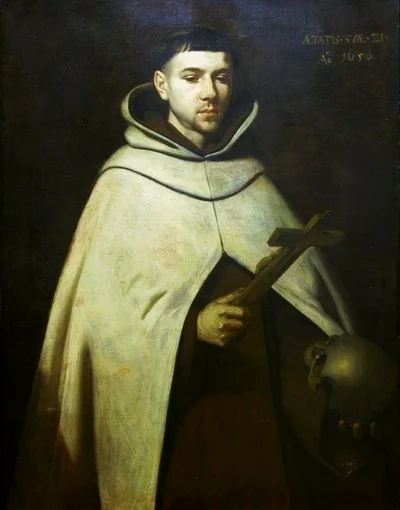
Who Is John of the Cross
John of the Cross (San Juan de la Cruz, 1542–1591), born Juan de Yepes y Álvarez, was a Spanish Carmelite friar, priest, mystic, and poet who—along with Teresa of Ávila—reformed the Carmelite order and produced some of the most profound mystical literature in Western civilization. Born into poverty in Castile, he studied at the University of Salamanca, entered the Carmelites, and was recruited by Teresa to help establish the Discalced (reformed) branch of the order. His reforming zeal earned him imprisonment by his own order’s unreformed faction: he spent nine months in a tiny cell in Toledo, subjected to psychological and physical abuse. It was during and after this imprisonment that he composed his greatest poetry—including “The Dark Night of the Soul” and “The Spiritual Canticle”—and began the theological commentaries that would make him one of the most important mystical writers in Christian history. He was declared a Doctor of the Church in 1926. (Wikipedia)
John’s relevance to IMHU’s mission is direct and urgent. His concept of the “dark night”—a period of profound spiritual desolation in which God seems absent, familiar consolations vanish, and the soul feels lost in a darkness it cannot understand or control—is one of the most important frameworks available for understanding what happens when spiritual transformation involves suffering rather than bliss. Modern clinicians and researchers increasingly recognize that many episodes of spiritual crisis, existential despair, and even certain presentations of depression involve dynamics that John described with extraordinary precision five centuries ago. His work provides a non-pathologizing framework for understanding darkness as a necessary stage of growth—not as failure, not as punishment, but as the psyche’s way of releasing attachment to limited forms of self and God so that a deeper union can emerge.
Core Concepts
- The dark night of the soul: John describes two distinct “dark nights”—the dark night of the senses (in which attachment to sensory and emotional consolation is purified) and the dark night of the spirit (a deeper, more devastating purification in which the soul’s most fundamental attachments—including attachment to spiritual experience itself—are stripped away). During the dark night, the person feels abandoned, spiritually dead, and unable to pray or connect with God in any familiar way. John insists this is not pathology but purgation: the darkness is actually an excess of divine light that the unprepared soul experiences as overwhelming darkness. This framework is indispensable for clinicians working with people in spiritual emergency or existential crisis.
- Nada (nothing) — the path of radical emptying: John’s famous diagram of the ascent of Mount Carmel includes the repeated word “nada”—nothing. The path to union requires letting go of attachment to everything: possessions, status, relationships, spiritual experiences, consolation, and even one’s own concept of God. This is not nihilism; it’s the recognition that any finite thing you cling to will eventually become an obstacle to the infinite. The clinical parallel is clear: sometimes the most transformative therapeutic work involves helping clients release identities, beliefs, and coping strategies that once served them but now imprison them.
- The living flame of love — transformation, not destruction: John’s final major poem and commentary describe the soul’s experience after the dark night: not annihilation but a living flame of love that transforms the person from within. The darkness was not the end of the story—it was the preparation for a union so intimate that the soul experiences itself as “wounded” by love in a way that is simultaneously painful and ecstatic. This insistence that the dark night leads somewhere—that it is purposive, not pointless—is what makes John’s framework therapeutic rather than merely descriptive.
- The three theological virtues as psychological transformation: John maps the dark night onto the three theological virtues: faith (which purifies the intellect by replacing certainty with trust in the unseen), hope (which purifies the memory by releasing attachment to the past), and love (which purifies the will by redirecting desire from finite objects to the infinite). This is a sophisticated psychology of transformation: each faculty of the soul undergoes its own purification, its own dark night, its own reorientation.
- Poetry as the language of mystical experience: John recognized that prose alone cannot convey the reality of mystical experience, so his primary texts are poems—dense, sensuous, multilayered lyrics that communicate through image and feeling what theological commentary can only approximate. His decision to use poetry is itself a teaching: some dimensions of experience can only be pointed at through metaphor, symbol, and beauty. This has implications for how clinicians listen to clients describing ineffable experiences.
Essential Writings
- The Dark Night of the Soul: Both a poem and a lengthy commentary, this is John’s most famous work and the source of the concept that has entered common language. The poem is brief and luminous; the commentary is a detailed spiritual psychology of purgation. Best use: the essential text for understanding the dark night—start with the poem, then read the commentary as you’re ready.
- The Ascent of Mount Carmel: A companion treatise to The Dark Night, this work covers the “active” purification that the soul undertakes through its own effort (as opposed to the passive purification God imposes). It includes John’s famous nada diagram and his teaching on detachment from sensory, intellectual, and spiritual attachments. Best use: the systematic framework—more demanding than the Dark Night commentary but essential for the full picture.
- The Spiritual Canticle: A poem and commentary modeled on the Song of Songs, describing the soul’s journey from longing through search to union with the Beloved. It’s John at his most lyrical and rapturous. Best use: the text to read after the dark night material—it shows where the journey leads.
- The Living Flame of Love: John’s most intimate and ecstatic work, describing the soul’s experience of transformative union. It’s short, intense, and written from the inside of the experience rather than about it. Best use: John’s final statement on what lies beyond the dark night—read it when you’re ready for the destination rather than the journey.
Image Attribution
Public domain: https://commons.wikimedia.org/wiki/File:Zurbar%C3%A1n_(atribuido)-John_of_the_Cross-1656.jpg