


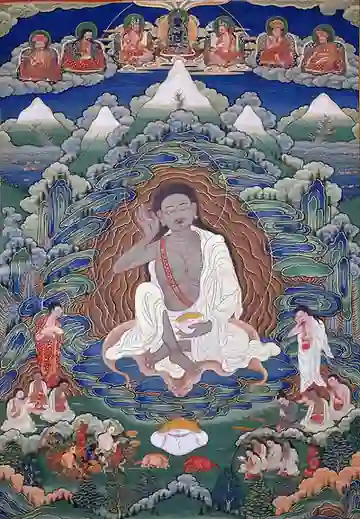
Who Is Milarepa
Milarepa (c. 1028–1105) is Tibet’s most beloved poet-saint and one of the central figures in the Kagyu lineage of Tibetan Buddhism. His life story—transmitted through the classic The Life of Milarepa and The Hundred Thousand Songs of Milarepa—is arguably the most dramatic spiritual biography in the Buddhist canon. Born into a prosperous family that was cheated of its inheritance after his father’s death, the young Milarepa turned to black magic at his mother’s urging and killed approximately thirty-five people at a wedding feast through sorcery. The weight of this act drove him to seek spiritual redemption, leading him to the great translator and teacher Marpa, who became his guru.
Marpa’s training of Milarepa is legendary for its severity: he subjected his student to years of grueling physical labor—building and tearing down stone towers repeatedly—before granting him any formal instruction. This ordeal, understood within the tradition as the purification of Milarepa’s enormous negative karma, eventually broke through his psychological defenses and opened him to genuine realization. After receiving the full transmission of tantric teachings (particularly the practices of tummo, or inner heat, and mahamudra), Milarepa spent decades meditating alone in remote Himalayan caves, wearing only a thin cotton cloth (earning him the epithet “Mila the Cotton-Clad”). He achieved complete enlightenment in a single lifetime—a feat considered extraordinary even within tantric Buddhism—and taught primarily through spontaneous songs and poems that are still studied, chanted, and cherished throughout the Tibetan world. His life demonstrates the Kagyu tradition’s core conviction: that no amount of past wrongdoing places awakening beyond reach, provided the practitioner brings sufficient devotion, effort, and willingness to be transformed.
Core Concepts
- Redemption through practice: no karma is beyond transformation
- Milarepa’s life is the tradition’s primary proof that even the most extreme negative karma—including murder through sorcery—can be purified through genuine practice, devotion to a qualified teacher, and sustained meditative effort. This teaching is central to the Kagyu school’s emphasis on the possibility of enlightenment in a single lifetime and offers a radically hopeful anthropology: the human capacity for transformation is unlimited. (Wikipedia)
- The guru-disciple relationship as crucible
- Marpa’s brutal training of Milarepa—the repeated building and demolishing of towers, the withholding of teachings, the apparent cruelty that masked profound compassion—illustrates the Kagyu understanding that the guru-disciple relationship is not about comfort but about dismantling the ego’s defenses. The hardship is the teaching; the resistance it provokes is precisely what must be worked through.
- Solitary retreat and the body as laboratory
- Milarepa’s decades of cave meditation embody the Kagyu emphasis on intensive, solitary practice as the primary vehicle of realization. His mastery of tummo (inner heat)—which allowed him to survive Himalayan winters in a cotton cloth—demonstrates the tradition’s understanding that the body itself, properly trained through yogic practice, becomes the instrument of awakening.
- Song as spontaneous teaching
- Milarepa’s poems and songs (doha) are not literary compositions but spontaneous expressions of realized experience—arising naturally from meditation and addressed to specific students, spirits, or situations. They embody the Kagyu conviction that authentic realization expresses itself naturally and accessibly, without need for scholastic elaboration.
Essential Writings
- The Life of Milarepa (by Tsangnyon Heruka, trans. Andrew Quintman or Lobsang P. Lhalungpa)
- The classic spiritual biography: from sorcery and mass murder through agonizing purification under Marpa to solitary realization in mountain caves. It reads like a novel and functions as a teaching on the totality of the path—including its darkest starting points.
- Best use: the essential starting point. Read it as story first; the doctrinal content will land naturally through the narrative.
- The Hundred Thousand Songs of Milarepa (trans. Garma C.C. Chang)
- The most comprehensive collection of Milarepa’s songs and teaching encounters, presenting him in dialogue with students, demons, dakinis, and fellow yogis across the Himalayan landscape. Each chapter is a self-contained teaching story built around one or more songs.
- Best use: the richest source of Milarepa’s actual teachings—dip in by episode rather than reading straight through.
- Drinking the Mountain Stream: Songs of Tibet’s Beloved Saint (trans. Lama Kunga Rinpoche and Brian Cutillo)
- A more compact selection of Milarepa’s songs with commentary, chosen for their practical meditation instruction. The translations emphasize clarity and accessibility.
- Best use: a meditation companion—shorter and more focused than the Hundred Thousand Songs, ideal for daily contemplative reading.