


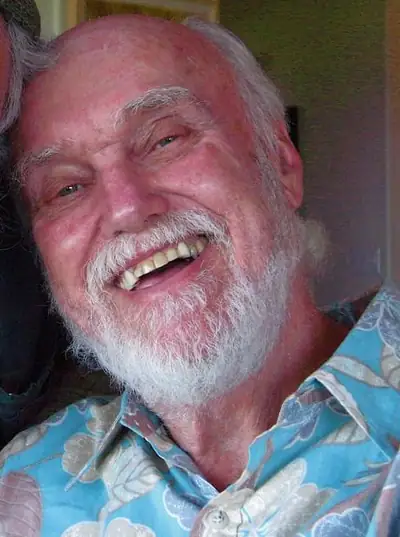
Who Is Ram Dass
Ram Dass (1931–2019), born Richard Alpert, was an American psychologist and spiritual teacher whose life arc traces one of the most dramatic and influential journeys in modern Western spirituality. As a young Harvard psychology professor in the early 1960s, he and Timothy Leary conducted the famous psilocybin experiments that got them both fired from the university. While Leary became the counterculture’s psychedelic evangelist, Alpert took a different turn: he traveled to India, met his guru Neem Karoli Baba (Maharaj-ji), and returned as Ram Dass—a teacher whose emphasis shifted from chemicals to consciousness, from getting high to waking up.
His 1971 book Be Here Now became one of the most widely read spiritual texts of the twentieth century, introducing an entire generation to meditation, devotion, and the idea that spiritual practice could be woven into ordinary Western life. Over the following decades, Ram Dass became a bridge figure—connecting psychedelic exploration with contemplative practice, Hindu devotion with Western psychology, and spiritual aspiration with grounded service. His work on conscious aging and dying (particularly after his own massive stroke in 1997) added another layer: he modeled how to meet suffering, limitation, and mortality as spiritual practice rather than spiritual failure.
Core Concepts
- “Be here now” — presence as the core practice: The central teaching is deceptively simple: most suffering comes from being mentally somewhere other than where you are. Ram Dass drew on Hindu and Buddhist frameworks to argue that the present moment is the only place where love, truth, and freedom are actually available. This isn’t just a meditation instruction—it’s a reorientation of the entire personality away from anxious future-planning and regretful past-dwelling. (Wikipedia)
- Psychedelics as a door, not the room: Ram Dass is one of the most honest voices on this topic. He freely acknowledged that LSD and psilocybin cracked him open and showed him states of consciousness he didn’t know existed. But he also came to see that psychedelics alone couldn’t sustain transformation—they showed you the view from the mountaintop, but you had to climb the mountain yourself through practice, service, and devotion. This nuanced position is enormously useful in today’s psychedelic renaissance.
- The guru relationship and devotional practice (bhakti): His relationship with Neem Karoli Baba was the pivot of his life. Ram Dass introduced Western audiences to the idea that a guru relationship—when authentic—isn’t about submission or cult dynamics, but about being mirrored by someone who sees you more clearly than you see yourself. He also brought devotional practice (kirtan, chanting, love of God-as-other) into spaces dominated by more intellectual or technique-based approaches, arguing that the heart is as valid a path as the mind.
- Suffering and service as spiritual practice: Ram Dass co-founded the Seva Foundation, worked with people who were dying, and—after his stroke left him partially paralyzed and speech-impaired—modeled the practice of meeting your own diminishment with humor, honesty, and grace. He taught that helping others isn’t separate from spiritual growth; it is spiritual growth, because it forces you out of the prison of self-preoccupation.
- “Loving awareness” as identity: In his later years, Ram Dass distilled his teaching to a single phrase: “I am loving awareness.” Rather than identifying with the body, the personality, or the thinking mind, he invited people to rest in the awareness that underlies all experience—and to notice that this awareness has the quality of love. It’s a remarkably simple practice that integrates Advaita Vedanta, bhakti, and mindfulness into something anyone can try.
Essential Writings
- Be Here Now (1971): The book that launched a thousand spiritual journeys. Part autobiography, part psychedelic art object, part practical manual, it tells the story of Alpert’s transformation into Ram Dass and introduces meditation, mantra, and devotion in a voice that’s warm, funny, and completely unpretentious. Best use: still the single best introduction to Ram Dass’s world—and still surprisingly fresh.
- The Only Dance There Is (1974): Transcripts of talks given at the Menninger Foundation and a yoga ashram. Looser and more conversational than Be Here Now, it captures Ram Dass thinking out loud about consciousness, therapy, psychedelics, and practice. Best use: a window into how he actually taught—spontaneous, self-deprecating, and deeply insightful.
- Still Here: Embracing Aging, Changing, and Dying (2000): Written after his stroke, this book applies his teachings to the territory of illness, aging, and mortality. He’s unflinchingly honest about what it’s like to lose capacities he once took for granted and finds in that loss an unexpected deepening of practice. Best use: essential reading for anyone working with aging, disability, or end-of-life care—or facing their own.
- Being Ram Dass (2021, posthumous): A memoir co-written with Rameshwar Das that covers his entire life, including his sexuality (he came out as bisexual), his complicated relationship with fame, and his decades of practice. Best use: the most complete and honest account of who Ram Dass actually was—warts, wonder, and all.
Image Attribution
“Ram Dass.jpg” by Gruznov, via Wikimedia Commons, licensed CC BY-SA 3.0. Link: https://commons.wikimedia.org/wiki/File%3ARam_Dass.jpg