


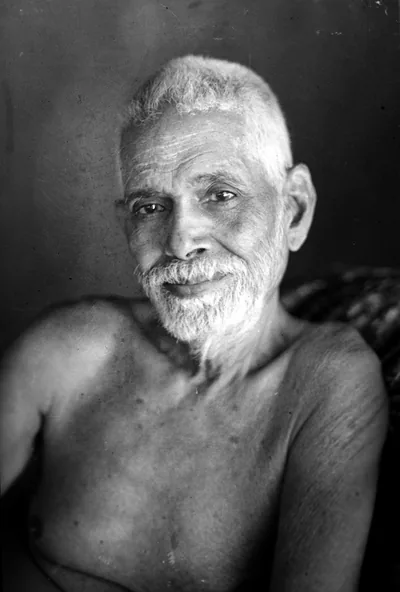
Who Is Ramana Maharshi
Ramana Maharshi (1879–1950), born Venkataraman Iyer, was an Indian sage and teacher of Advaita Vedanta who is widely regarded as one of the most important spiritual figures of the twentieth century. At age sixteen, living an ordinary life as a student in Madurai, he underwent a sudden and spontaneous experience of “death”—a complete dissolution of his identification with the body and mind—that left him permanently established in what he described as the Self (Atman), the pure awareness that underlies all experience. Shortly afterward, he left home and traveled to Arunachala, the sacred mountain in Tiruvannamalai, Tamil Nadu, where he remained for the rest of his life. For the first years he barely spoke, sitting in silence in caves and temples. Gradually, seekers gathered around him, and over the decades a community (ashram) formed, but Ramana never sought students, never established an organization, and never traveled or promoted himself.
Ramana’s relevance to IMHU’s mission is distinctive. While most figures in IMHU’s orbit approach consciousness through research, clinical practice, or tradition-based instruction, Ramana represents the phenomenon of spontaneous awakening itself—and his teaching is essentially a single, endlessly refined instruction for anyone who wants to investigate the nature of their own awareness directly. His method of self-inquiry (vichara)—persistently turning attention toward the source of the “I”-thought—is one of the most streamlined contemplative practices ever articulated. It requires no belief system, no ritual, no institutional framework. For clinicians and researchers interested in what non-dual awareness actually is, how it arises, and what it does to the person who stabilizes in it, Ramana’s life and teaching provide an unusually clear case study. His influence extends through virtually every modern non-dual teacher, from Nisargadatta Maharaj to Eckhart Tolle to Adyashanti.
Core Concepts
- Self-inquiry (Atma Vichara) — “Who am I?”: Ramana’s central and essentially only method. Rather than controlling the mind through concentration or cultivating particular states, self-inquiry involves turning attention inward and asking “Who am I?” whenever a thought, emotion, or identification arises. The question is not meant to produce an intellectual answer but to redirect attention toward the source of the sense of “I”—the awareness that is prior to all content. Practiced persistently, it dissolves identification with the body, mind, and personality and reveals what Ramana called the Self—pure, unchanging awareness. This method has influenced contemplative practice far beyond its Advaita Vedanta origins. (Wikipedia)
- The Self (Atman) as pure awareness: Ramana taught that what we truly are is not the body, the mind, the emotions, or the personality but the awareness in which all of these appear. This awareness is not personal—it is the same consciousness that underlies all experience, in all beings, at all times. He used the metaphor of a screen on which movies play: the screen is unchanged by whatever drama appears on it. This teaching provides a framework for understanding experiences of ego dissolution, depersonalization, and expanded awareness that can occur during meditation, psychedelic experiences, or spontaneous spiritual opening.
- The unreality of the ego: Ramana taught that the ego—the sense of being a separate, individual “I”—is not a real entity but a mistaken identification. It arises when pure awareness identifies with a particular body and mind and says “I am this.” Self-inquiry works by tracing this “I”-thought back to its source, where it dissolves into the awareness that was always already present. This is not a theoretical position but an experiential claim: investigate the “I” and you will find that it has no independent existence.
- Silence as the highest teaching: Ramana’s most powerful teaching was often his silence. He spent years in almost complete silence, and even after he began speaking, he maintained that silence—the direct transmission of awareness through presence—was more effective than words. Seekers reported that simply sitting in his presence produced profound shifts in consciousness. This has implications for how we understand therapeutic presence, the non-verbal dimensions of healing, and the power of being with someone who is deeply established in awareness.
- Surrender and self-inquiry as two paths to the same destination: While self-inquiry was his primary method, Ramana also taught the path of surrender (prapatti)—complete submission of the ego to God or the Self. He described these as two approaches suited to different temperaments but leading to the same result: the dissolution of the false sense of separate selfhood. For the self-inquiry path, you trace the “I” to its source; for the surrender path, you offer the “I” to the divine. Either way, the ego is released.
Essential Writings
- Who Am I? (Nan Yar?, 1902): Ramana’s earliest and most concise statement of his teaching, originally written in response to questions from a seeker. In just a few pages, it lays out the entire method of self-inquiry and the understanding of the Self. Best use: the essential starting point—brief enough to read in one sitting, deep enough to practice for a lifetime.
- Talks with Sri Ramana Maharshi (recorded 1935–1939): A massive collection of conversations with seekers, recorded by devotees. It covers every conceivable question about self-inquiry, meditation, the nature of the Self, the relationship between practice and grace, and the integration of awakening with ordinary life. Best use: the most comprehensive source for Ramana’s teaching in his own words—best read slowly, a few pages at a time.
- Be As You Are: The Teachings of Sri Ramana Maharshi (edited by David Godman, 1985): A thematically organized selection from Ramana’s dialogues, with clear introductions by Godman. Best use: the most accessible entry point for Western readers—well-organized, well-edited, and immediately practical.
- The Spiritual Teaching of Ramana Maharshi (foreword by C.G. Jung, 1972): A compact collection of three of Ramana’s core texts with an introduction by Jung that discusses the relationship between Eastern self-realization and Western psychology. Best use: a fascinating bridge text—Jung’s foreword alone is worth the price of admission for anyone interested in the dialogue between depth psychology and non-dual spirituality.