


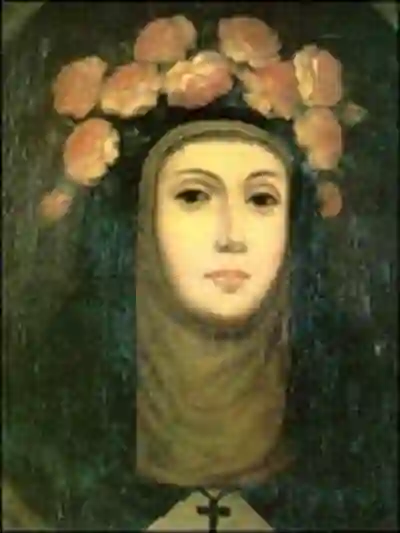
Who Is Rose of Lima
Rose of Lima (1586–1617), born Isabel Flores de Oliva in Lima, Peru, was the first person born in the Americas to be canonized as a saint by the Catholic Church. From an early age she exhibited an intense devotional life, modeling herself on Catherine of Siena and committing to a path of prayer, fasting, and service that defined her short but extraordinary life. She took the name Rosa after her mother noted her beauty as an infant, and later added “of Saint Mary” upon her confirmation, though she is universally known as Rose of Lima.
Rose’s spiritual significance extends well beyond Catholic hagiography. She created a small infirmary in her family’s home where she cared for sick and hungry Indigenous people and enslaved Africans, making her one of the earliest advocates for social service in the colonial Americas. Her mystical experiences—visions, ecstatic states, and reported miracles—place her firmly in the tradition of Christian contemplative mysticism, alongside Teresa of Ávila and John of the Cross. While some modern readers struggle with the severe asceticism she practiced, her life is better understood within the context of colonial Latin American spirituality, where physical discipline was seen as a pathway to union with God and a form of solidarity with the suffering of Christ and the oppressed.
Core Concepts
- Mystical union through contemplation and devotion
- Rose’s spiritual life centered on achieving direct experiential communion with God. She spent extended hours in solitary prayer and contemplation, cultivating a relationship with the divine that she described in terms of intimate presence. Her mystical experiences—including visions, locutions, and states of spiritual ecstasy—align her with the broader Christian mystical tradition of infused contemplation. (Wikipedia)
- Service to the marginalized as spiritual practice
- Rose’s care for the sick, poor, Indigenous, and enslaved populations of Lima was not an afterthought to her spiritual life but central to it. She understood service as an expression of love for God made concrete in love for neighbor, and her home infirmary became a model for religiously motivated social care in the Americas. This integration of contemplation and action anticipates later developments in liberation theology.
- Asceticism as transformation, not mere denial
- Rose practiced severe physical austerities—fasting, sleep deprivation, and mortification. Within her tradition, these practices were understood not as self-punishment but as methods for purifying desire, deepening dependence on God, and cultivating compassion through voluntary participation in suffering. Modern readers may benefit from viewing these practices as analogous to the intensive disciplines found in many contemplative traditions worldwide.
- Colonial Latin American mysticism and feminine spiritual authority
- Rose operated in a context where women had virtually no formal religious authority, yet she became one of the most influential spiritual figures in the colonial Americas. Her path—creating a semi-monastic life within her family home, attracting followers, and gaining recognition from church authorities—illustrates how mystical experience could serve as a source of feminine spiritual power even within rigidly patriarchal structures.
Essential Writings
- No surviving written works: Rose of Lima did not leave behind published writings. What we know of her spiritual life comes primarily from testimony gathered during her canonization process and from early biographies written by those who knew her or compiled the evidence for her sainthood. The most important early source is the account by Leonardo Hansen, OP (1664), and various canonization documents preserved in Vatican archives.