


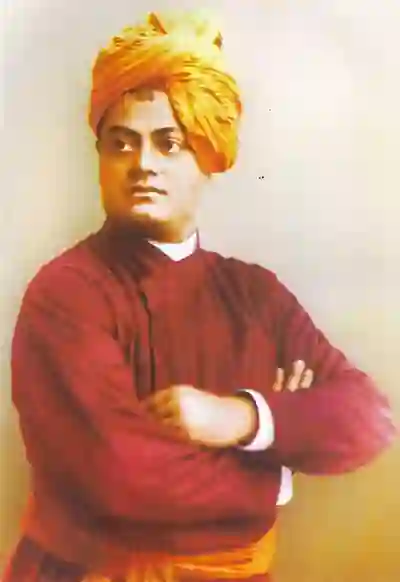
Who Is Swami Vivekananda
Swami Vivekananda (1863–1902), born Narendranath Datta in Calcutta, was a Hindu monk, philosopher, and the foremost disciple of the Indian mystic Sri Ramakrishna. He is widely credited with introducing Vedanta philosophy and Yoga to Western audiences and with elevating Hinduism to the status of a major world religion in the eyes of the global intellectual community. His defining moment came at the 1893 World’s Parliament of Religions in Chicago, where his opening words—“Sisters and brothers of America”—electrified the audience and launched him into international prominence. Over the next several years, he lectured across America and Europe, founded the Vedanta Society of New York (1894) and the Ramakrishna Mission in India (1897), and produced a body of teachings that continues to shape how both Eastern and Western audiences understand Indian spiritual philosophy.
Vivekananda’s significance for IMHU’s mission lies in three things: his insistence that spirituality must be experiential, not merely doctrinal; his synthesis of multiple yoga paths into a practical system accessible to people of all temperaments; and his radical claim that service to others is itself a form of worship—because every human being is, in essence, divine. Trained first in Western logic and skepticism through the Brahmo Samaj, then transformed by Ramakrishna’s intensely experiential mysticism, Vivekananda embodied the integration of rational inquiry and direct spiritual realization that characterizes the best of integrative approaches to human development. He died at just 39, but his influence—on figures from Mahatma Gandhi and Jawaharlal Nehru to Leo Tolstoy and Nikola Tesla—has been enormous and enduring.
Core Concepts
- “Each soul is potentially divine”—Practical Vedanta
- Vivekananda’s signature teaching is that the purpose of human life is not to become divine but to manifest the divinity that is already your essential nature. This reframes spiritual practice as a process of removing the obstacles (ignorance, attachment, egoic conditioning) that obscure what is already there—rather than acquiring something you lack. He called this “Practical Vedanta” because he insisted it must be lived in daily action, not confined to philosophical abstraction. (Wikipedia) (Vedanta Society)
- The four yogas as complementary paths
- Vivekananda systematized four classical paths of yoga for modern audiences: Jnana Yoga (the path of knowledge and philosophical inquiry), Bhakti Yoga (the path of devotion and love), Karma Yoga (the path of selfless action and service), and Raja Yoga (the path of meditation and mental discipline). His key insight was that these are not competing alternatives but complementary approaches suited to different temperaments—and that most people benefit from practicing elements of all four. His 1896 book Raja Yoga was particularly influential in shaping Western understanding of yoga as a systematic mental discipline rather than merely a physical practice.
- The harmony of religions
- Following Ramakrishna’s experiential realization that different religious paths can lead to the same truth, Vivekananda became one of the earliest and most articulate advocates of religious pluralism on the world stage. He didn’t argue that all religions are identical, but that they are different paths up the same mountain—each valid, each partial, each suited to different human needs and cultural contexts. This was radical in 1893 and remains relevant in an era of increasing interfaith engagement.
- Service as worship—“Jiva is Shiva”
- Vivekananda took Ramakrishna’s teaching that every living being is a manifestation of the divine and translated it into a social ethic: if every person is God in disguise, then serving the poor, the sick, and the marginalized is literally serving God. This was a genuine innovation—classical Advaita Vedanta had little to say about social service—and it became the founding principle of the Ramakrishna Mission, which to this day runs hospitals, schools, and disaster relief programs across India and the world.
- Strength and fearlessness as spiritual virtues
- Unlike many spiritual teachers who emphasize gentleness and withdrawal, Vivekananda consistently preached strength, courage, and self-confidence as essential to the spiritual path. “Arise, awake, and stop not till the goal is reached” was his rallying cry. He saw weakness—physical, mental, and moral—as the greatest obstacle to spiritual realization, and he pushed his followers to cultivate both inner resilience and outward effectiveness. This emphasis on spiritual strength makes him especially relevant for people navigating crisis, burnout, or post-traumatic growth.
Essential Writings
- Raja Yoga
- Vivekananda’s most influential book in the West: a systematic presentation of Patanjali’s Yoga Sutras reframed as a practical manual for mental discipline, concentration, and the direct investigation of consciousness. Published in 1896, it was an instant bestseller and fundamentally shaped how Western audiences understood yoga—not as physical exercise but as a science of the mind.
- Best use: the essential starting point for anyone who wants to understand yoga as a contemplative and psychological discipline, not just a physical practice.
- Karma Yoga
- Vivekananda’s exposition of the path of selfless action—the idea that you can transform work itself into a spiritual practice by letting go of attachment to outcomes and dedicating your effort to something larger than your ego. It’s deceptively simple and endlessly practical.
- Best use: for high achievers, burned-out professionals, or anyone who needs a framework for making their daily work meaningful without collapsing into workaholism.
- Jnana Yoga
- A series of lectures on the path of knowledge—the Vedantic approach to liberation through philosophical inquiry, discrimination between the real and the unreal, and the direct realization that the individual self (Atman) and the ultimate reality (Brahman) are one.
- Best use: for philosophically inclined readers who want to understand Advaita Vedanta from its most accessible modern interpreter.
- The Complete Works of Swami Vivekananda
- The definitive multi-volume collection of Vivekananda’s lectures, letters, poems, and conversations. Sprawling and uneven (as any collected works will be), but containing passages of extraordinary power and insight—and the best way to encounter the full range of his thought.
- Best use: a lifetime reference text. Dip in by topic rather than reading cover to cover.