



Common Signs of a Spiritual Awakening
One of the earliest signs of a spiritual awakening is heightened sensitivity, mood swings, existential questioning, grief, and a sense of identity “shedding.”
For example, let me tell you about Marcelo, a Brazilian man I met in Brazil, who has a dramatic story he lets me tell. He was leading a normal life—work he enjoyed, a circle of friends, and having fun in São Paulo, where he lived. When he was 28 years old, things changed. He became depressed. He began feeling like bugs were crawling on his skin. He started hearing voices in his head. He felt sure he was going crazy and became very moody. His psychiatrist believed he was psychotic and prescribed antipsychotics. Nothing seemed to help until he went to a Spiritist psychiatric hospital, which is a popular form of psychiatric hospital in Brazil that integrates modern psychiatric tools with spiritual healing methods
After a thorough physical exam and an interview to determine his stressors, the healthcare team recognized that Marcelo was a gifted healer who needed training to harness his sensitivities. He began studying to become an energy worker. He made friends with other healers and received training. Within months, he was living outside the hospital, happy, and with a new direction in his life. In fact, he began returning to the hospital to offer spiritual healing to those who had once been his fellow patients. Not all stories of spiritual awakening are as dramatic as Marcelo’s, but his story illustrates the positive outcomes that can arise when awakening experiences are appropriately supported by skilled healthcare providers.
Stories like Marcelo’s remind us that a spiritual awakening can look disruptive on the surface while still leading to meaningful growth in consciousness and daily function. (Note: The Spiritist model of care for people who are awakening is far more developed in Brazil than anywhere else in the world. See IMHU’s online course on Spiritism to learn more about it.)
During and after a spiritual awakening experience, it is normal to become more sensitive—sensing the feelings of others, as Marcelo did, as well as your own emotions. Some people report a sense of another presence, such as a spirit guide. When these experiences disrupt your habitual way of seeing yourself, they can provoke profound questions: What is this all about? Am I going crazy? Who am I, really? What is most meaningful in my life?
Such questioning may bring regrets—for example, realizing you have spent too much time on things that no longer feel meaningful. It can also create disorientation and instability while you sort through existential questions. When managed skillfully, however, this process can lead to a far more fulfilling life. At this stage, people often reexamine core beliefs about identity, success, and reality, and that reevaluation is a classic feature of awakening.
For example, the YouTube channel Regards Rei, which describes the creator's process of spiritual awakening, does a wonderful job of illustrating the critical examination and reorientation of one’s life that can occur as a result of an awakening experience.
Caution Signs: When Support Is Essential
Warning signs include: severe insomnia, inability to function, paranoia, reckless behavior, and extreme agitation.
For some, the awakening process can be intense. Even alongside moments of epiphany, there may be dark periods of anxiety and fear, including questions like, Am I crazy? You may have trouble sleeping, going to work, managing household tasks, or attending to personal hygiene. There may be a desire to isolate and avoid leaving the house.
For others, the excess energy can express itself through risky behavior. One young female IMHU client was apprehended by police for energetic dancing in very little clothing in the middle of the night, in parts of a city known to be dangerous. She urgently needed safety and containment, as her behavior put her life at risk. A short stay in the hospital provided that safety. In some cases, the process can feel like a “dark night of the soul”, when orientation is lost; this is where containment, clinical discernment, and compassionate support are essential during spiritual awakening.
A Clear Stance
Safety and stability are not “less spiritual”—they are foundational.

I often liken spiritual awakening to a snake shedding its skin. The old skin (identity) no longer fits, creating discomfort and the need to withdraw from usual activities. During this process, snakes are nearly blinded by a thin film covering their eyes as the skin tightens. They hide because they feel vulnerable. Eventually, they rub against a rough surface, tear the old skin, and slowly wriggle free—shedding both the skin and the film over their eyes. This process frees them of parasites and gives them a fresh start: a new skin that is more flexible, vibrant, and able to support further growth.
Similarly, being in a safe space during a spiritual awakening is crucial. Ideally, it offers quiet, consistent support and companionship that welcomes vulnerability and emotional expression. In such an environment, it becomes acceptable to rest, take time out, feel vulnerable, express feelings, and receive care—nutritious food, respect, and reassurance that the spiritual journey is worthwhile.
If you’d like to receive training on how to support someone during a challenging spiritual awakening process, IMHU trains coaches to provide appropriate support and discernment through online and on-location courses.
Stages of Spiritual Awakening
Disruption: crisis, loss, disillusionment—“something isn’t working.”
What once felt natural and normal no longer fits. You may not understand why what previously worked now feels wrong. This disruption can arise spontaneously or follow a loss, such as the death of a beloved parent. You begin questioning yourself and your life. This phase of spiritual awakening often shakes inherited beliefs and heightens sensitivity to what is no longer aligned.
Opening: expanded awareness, synchronicities, insights, and increased sensitivity.
In response, you may turn to spiritual practices such as prayer or meditation retreats to regain a sense of balance. Some seek insight through psychedelics or plant medicines. These experiences may expand awareness of who you are at a soul level.
Sensitivity typically increases to yourself, others, and the natural environment. When we feel lost, we look for signs. As awareness opens, synchronicities may appear: meaningful coincidences that seem to point the way forward. For example, I once “chanced” to meet a forensic psychiatrist in Brazil while trying to understand the circumstances of an unexpected death in my family. He gave me exactly the information I needed. Synchronicity. Opening can also involve fascination with mediumship, spiritual healing, or psychic abilities. You might consult a medium or pursue training to refine intuitive knowing.
As people become more awake, they often experience reality as more interconnected, and this shift in consciousness can feel like life is speaking to them in symbols, or as if things are being orchestrated by a higher power. For many, this is where spirituality becomes lived experience rather than theory, and the spiritual journey starts to feel personally undeniable.
Purification: old patterns surface like grief, fear, anger, and nervous system volatility.
As your sense of self expands, you may become acutely aware of limiting thought and behavior patterns—particularly those shaped by social and cultural conditioning. Strong emotions often arise: shame, anger, and fear of being trapped in these patterns forever.
One IMHU client, whom I’ll call Ginger, was labeled schizophrenic at age 19 and hospitalized for nearly 20 years. Over time, she internalized an identity of being mentally ill and disabled. After her release from the hospital, as her therapist, maintaining clear boundaries and not imposing a diagnosis or belief system, I supported her as she opened up about early-life trauma. At the same time, she practiced prayer and meditation that resonated with her.
Grief, fear, anger, exhaustion in response to the past and a refreshing desire for simple pleasures—music, camping, growing flowers—all arose together, tangled and overlapping. Gradually, Ginger began to feel more whole, present, authentic, connected to the Divine, and happier. She now gets along well on a very modest dose of one pill, having withdrawn under MD supervision from a handful of pills formerly prescribed to her.
Reorientation: values shift; relationships and work reorganize.
Reorientation is where spiritual awakening becomes practical: choices, relationships, and work begin to reflect revised beliefs about what truly matters. Many people describe this phase as becoming more spiritually grounded while also becoming more realistic about limits, boundaries, and safety. A key marker here is alignment between daily life and soul values, not just peak experiences.
As Ginger released her old identity, she realized she wanted relationships aligned with her values and a new way of engaging with the world. She also sought a deeper connection with what she called “God.” Reflecting on her early life, she clarified a new relationship with both people and the Divine—one arising from deep inner knowing and spiritual experiences she had had in nature as a child.
I shared with her that I trusted her deepest Self and the life-affirming messages she was receiving. With her permission, I also remained prepared to coordinate with her physician if emergency support became necessary.
Today, Ginger expresses a desire to help others trapped in negative self-talk and unsupportive relationships. She speaks from lived experience. While happiness is not constant, she has found a new orientation in her life and new resources to navigate challenges.
Integration: steadier baseline; humility; embodiment; service and alignment.
Integration unfolds gradually. We know it is occurring when we feel steadier, more whole, and more embodied. As old limitations fall away, there is deeper relaxation and less ego identification. Rather than self-aggrandizement, there is often humility and a desire to serve others.
Integration means this way of being is lived, not just understood. You may reengage with life—camping with a friend, as Ginger did, volunteering at a soup kitchen, or caring for animals in a rescue center.
In integration, people also often report that spiritual awakening no longer feels dramatic; instead, it feels stable, humane, and quietly transformative in everyday reality. A mature process brings a less defensive ego, more compassion, and clearer discernment about which spiritual teachers encourage grounded growth. At this stage, spiritual awakening expresses itself through soul-level steadiness and embodied care for oneself and others.
A Spiral, Not a Straight Line
Stages loop and repeat; they are not linear. Although we like to imagine awakening as a straight path with a clear beginning and endpoint, it is better understood as a spiral—revisiting the same terrain at increasingly mature levels. Experiences repeat, but we bring greater wisdom, compassion, and resources.
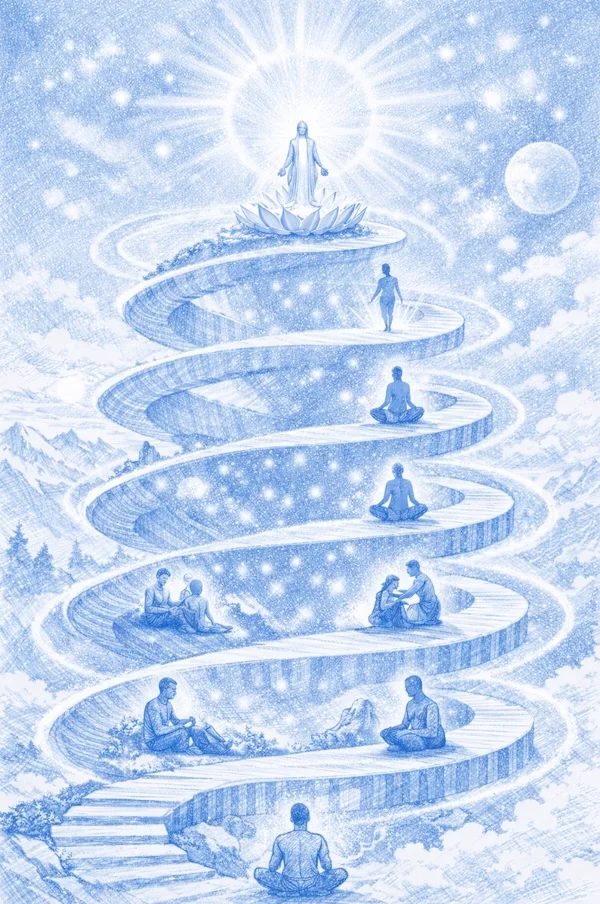
For example, a teacher who terrified us in childhood may still seem intimidating in adolescence, yet later be recognized as someone needing compassion. Our unmet needs for love in childhood may first manifest as sadness, later anxiety as we attempt to love others as young adults, and eventually insight that loving relationships are magnetized by cultivating our capacity for unconditional love of ourselves first.
Revisiting feelings from the past is not failure. Feeling grief again—even decades after a loss—means we are alive and human. With integration, we can feel deeply without becoming lost in the feeling. Tears may come for a bit, followed by prayer and gratitude, and then continued, full engagement with life in the present moment.
This spiral pattern is common in awakening and in the longer spiritual journey: each return revises old beliefs and shifts perspective. At times, it can feel like another dark night, yet each cycle can leave us more awake and less fused with our old patterns and narratives. The repeated cycles in spiritual awakening are not a failure state. It is the process of human evolution at work.
The Endpoint or Goal?
Some traditions describe a clear endpoint; others do not. Having a goal is optional. Expanding consciousness and living authentically in the present moment may be sufficient. Climbing Mount Everest is not for everyone. It requires discipline, courage, strength, balance and guidance from someone who intimately knows the path. Still, it can be important to know such a summit exists.
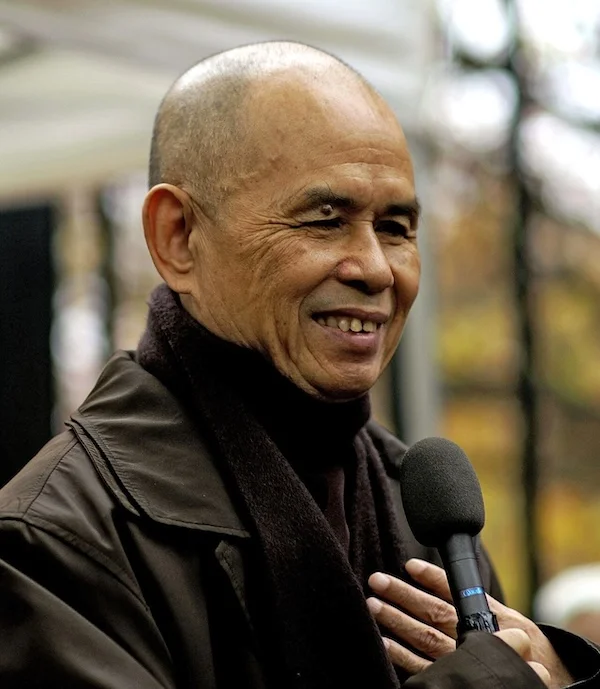
“Enlightenment is when a wave realizes it is the ocean.” —Thich Nhat Hanh
Popularized Yogic and Hindu Perspectives
Sanātana Dharma, the “eternal science of Truth,” describes the highest peak of awakening as Self-realization. In this framing, enlightenment is not about personal status. The typical notions of self-absorption fall away. Instead, it is the direct recognition of the deeper reality underlying ordinary perception.
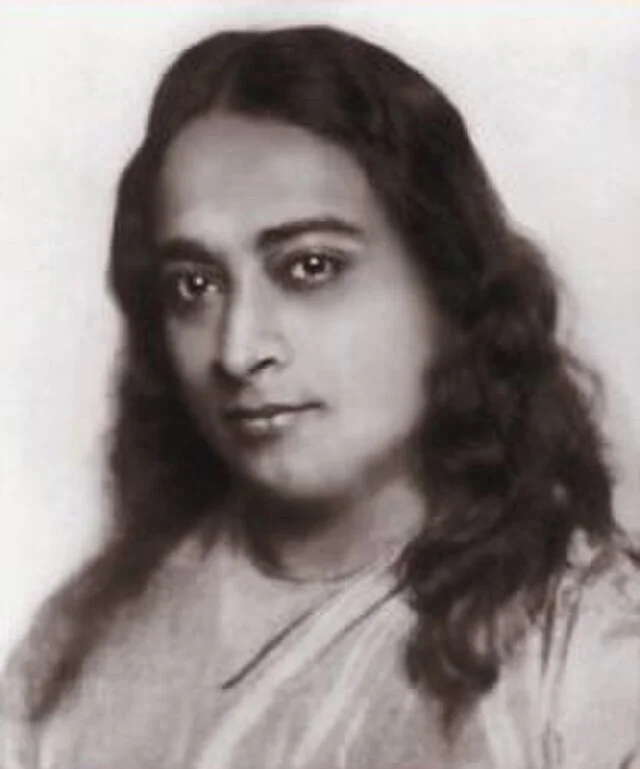
Paramahansa Yogananda, widely regarded as an enlightened being, described this state as ever-new bliss: omnipresence, omniscience, omnipotence—not ego-based power, but divine alignment—along with infinite peace and the recognition of all beings as divine sparks. He emphasized that daily meditation is essential in pursuit of enlightenment.
To support this, he founded the Self-Realization Fellowship (SRF) in 1925. SRF preserves and shares his teachings worldwide, offering instruction freely or at minimal cost. As an SRF member, I value the universality of his teachings, which bridge yogic and Christian traditions. His teaching emphasizes disciplined spirituality, training attention so awareness can remain awake under changing life conditions.
Popularized Hindu Teachings

Richard Alpert, PhD (Ram Dass), studied with Neem Karoli Baba and helped bring Eastern spirituality to the West. He described his mature realization as “loving awareness” and “becoming nobody”—disidentifying with ego and serving others.
Advaita Vedānta, often called non-dualism, teaches relinquishing ego to experience oneness. Teachers such as Ramana Maharshi, and later Gangaji, Rupert Spira, Adyashanti, and Eckhart Tolle, brought these teachings to broader audiences.
These spiritual teachers repeatedly warn that refined ego structures can imitate insight, so honest self-observation remains essential throughout spiritual awakening.
For many readers, studying trusted spiritual teachers can support discernment during awakening without replacing direct experience.
Popularized Buddhist Teachings

Jack Kornfield, PhD, helped popularize mindfulness meditation in North America, describing awakening as increased compassion, expanded awareness, and presence.
Shunryu Suzuki, a Zen Buddhist abbot, described the endpoint as realizing “emptiness”—not annihilation, but freedom from unnecessary suffering. As his student from 1967 to 1971, I learned that emptiness means less ego attachment, less fear and reactivity, and deeper compassion. It brings a lived sense of interdependence with all life.
In summary: The self is not a fixed, separate entity. Thoughts and emotions arise and pass. We are deeply interconnected. Attachment to identity, certainty, or control creates suffering (passivity is not recommended; instead, following the deepest heart’s conscience)
Many teachers suggest that stabilizing at this realization means there is no need to reincarnate—the earth plane being a school for learning the above lessons. From this perspective, enlightenment is not escape from life, but freedom from compulsive grasping and defensive ego contraction. A practical test of mature spiritual awakening is whether compassion, humility, and responsibility increase over time. Healthy spirituality keeps us relational, embodied, and ethically accountable, not inflated or grandiose. Across traditions, spiritual teachers tend to agree that genuine realization deepens service, steadies the nervous system, and clarifies values.
Integration notes for a spiritual awakening
- Repeating cycles of awakening do not mean regression; they often mean deeper layers are surfacing for integration.
- A heightened nervous system does not automatically indicate pathology, but persistent dysfunction requires professional support.
- During intense phases, people may feel like they are losing control; compassionate structure often restores stability.
- As spiritual awakening matures, many people report less fascination with dramatic states and more commitment to grounded care.
- Reliable progress on the spiritual journey usually includes better sleep, better boundaries, and more coherent relationships.
- A soul-oriented lens can coexist with clinical care when both are used with humility and evidence-informed discernment.
- Lasting transformation in consciousness is measured less by peak moments and more by stability over time.