


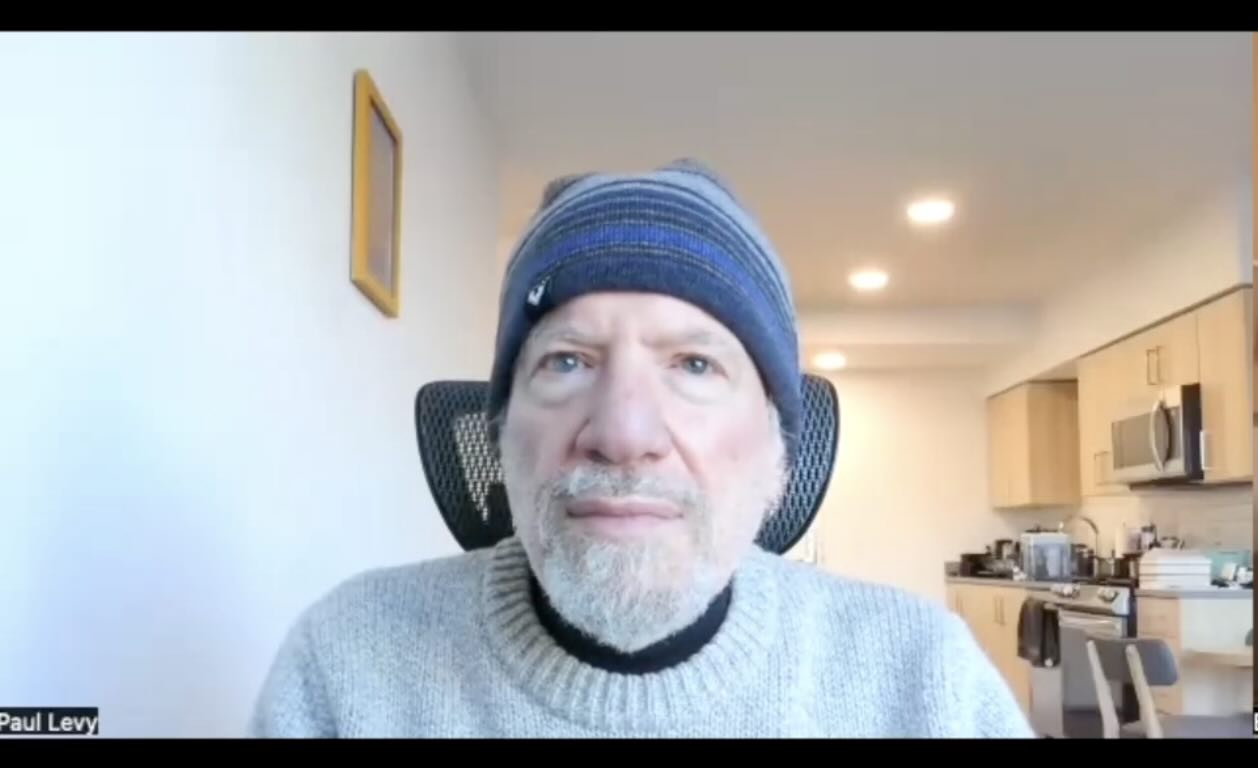
Awakening From Collective Psychosis: A Conversation with Paul Levy
Full Video
Paul Levy discusses spiritual emergence and his view that the U.S. and the world are in a transitional “bardo” marked by collective psychosis, polarized opposites, and increasingly visible darker forces, with outcomes ranging from collective suicide to global awakening. Using the caterpillar-to-goo-to-butterfly process and “imaginal cells,” he frames conflict as an essential part of metamorphosis and says what’s revealed through darkness can unlock creativity if recognized as something unconscious within us. Levy draws on his own 1981 awakening, subsequent hospitalization, and decades of integration, emphasizing mindfulness, meditation, and expressed creativity as antidotes to a repressed creative spirit. He credits long relationships with Tibetan Buddhist teachers for embodying love and compassion, and describes his own therapeutic approach as relating to people as already whole, healed, and awake.
00:00 Introduction
01:17 Collective Psychosis & The Butterfly Metaphor
04:11 Holding the Tension of Opposites
06:57 Moving Into the Positive Potential
08:05 True Nature & Creative Expression
08:30 The Dreamlike Nature of Reality
10:06 Meditation & Tibetan Buddhism
12:47 Relating to Others as Whole & Healed
14:29 Letting Your Light Shine
Humanity is in a painful but potentially transformative collective crisis
Paul Levy’s central argument is that the chaos, polarization, and darkness we see in society are not just random breakdowns but signs of a deeper transitional process. He uses the caterpillar-to-butterfly metaphor to explain this: before a butterfly emerges, the caterpillar dissolves into a kind of “goo,” which looks like disintegration but is actually part of metamorphosis. In the same way, he believes the United States, and really the wider world, may be in a destabilized phase that contains two real possibilities at once: collective destruction or collective awakening. The conflict itself is not necessarily proof that things are failing beyond repair. It may be the very condition through which a higher form of consciousness and social life could emerge.
The real task is to hold inner and outer conflict without collapsing into one-sidedness
A second major point is psychological and spiritual: Levy says the polarization we see in politics and culture mirrors a polarization inside the human psyche. His view is that people tend to identify with one side of a conflict and project the rejected side outward, which only deepens division and sickness. Drawing from Jung, he argues that growth happens when a person can consciously hold the “tension of opposites” instead of prematurely escaping discomfort. When that tension is endured with awareness and integrity, something new can arise that the ego could not have invented on its own, what Jung called the transcendent function. So for Levy, the path through this moment is not denial, reactivity, or ideological certainty, but deeper consciousness, emotional stamina, and the ability to stay present inside contradiction until something wiser emerges.
Meditation, creativity, and seeing people as already whole are practical ways forward
Levy does not leave the conversation at the level of abstract philosophy. He gives a practical direction: people need to reconnect with their true nature, which he describes as inherently creative, loving, and compassionate. He says one of the greatest poisons in the psyche is repressed creativity, so creative expression is not a luxury but part of healing and awakening. He also strongly emphasizes meditation, especially mindfulness, as a foundational discipline for stabilizing spiritual insight. Just as important, he speaks about the healing power of being seen by others not as broken or pathological, but as whole and awake beneath the wounds. That view shaped his own recovery after being pathologized by psychiatry, and it became part of how he now works with others. His deeper point is that awakening is supported by practices and relationships that help remove what obscures our deeper nature so that our “light” can shine more freely.